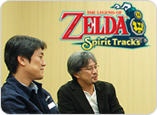
Iwata Asks - The Legend of Zelda: Spirit Tracks

Iwata Asks

The Legend of Zelda: Spirit Tracks

1. The Previous Game Felt As Though We’d Given Our All

Iwata:
All right, to start off, please introduce yourselves.
Aonuma:
I’m Aonuma, from Entertainment Analysis & Development. I produced this game, The Legend of Zelda: Spirit Tracks, and I also produced the previous game, The Legend of Zelda: Phantom Hourglass1.


1 Phantom Hourglass is “The Legend of Zelda: Phantom Hourglass”. It is a stylus-controlled action-adventure game, and the first Nintendo DS title in the Zelda series. It was released in June of 2007 in Japan and in October of 2007 in Europe.
Iwamoto:
I’m Iwamoto, of the same department. I acted as director for this game, as with the previous game.
Iwata:
Aonuma-san, you’re involved with both the Wii and DS editions of "Zelda". Are there any differences in how you work on the two?
Aonuma:
When I work on the Wii edition, I’m right on-site, and I often do my job from a director’s perspective. On the DS version, I do proper producer’s work. …That said, when I worked on the previous game, Phantom Hourglass, I was simultaneously making Twilight Princess2, so I couldn’t keep a very close eye on things right from the beginning. Then, when Twilight Princess was finished and I went to the DS version’s office, the development was already pretty far along. From my point of view, it was at a stage where I could really make myself useful.


2 Twilight Princess is “The Legend of Zelda: Twilight Princess”. It is an action-adventure game that was released in December of 2006 as software for both Wii and Nintendo GameCube.
Iwata:
So you’re saying that you left the site for a while, and that let you see the DS version with a new set of eyes. As a result, you were able to spot the places where you could put in a little more work and really improve things.
Aonuma:
That’s exactly it. So then – and I did feel bad to do so – I asked that development be extended three more months, and I worked on it during that extra period. Then, the more I worked, the better it got.
Iwata:
Yes, I’d heard something about that, too. I heard that the quality of the previous game improved tremendously during the final stages of development.
Aonuma:
And then we had Iwamoto direct this time just as he did with the last game. About half of the staff had been involved in Phantom Hourglass as well, so I left matters in their hands to a certain extent. And, again, for about the final two months of development…
Iwamoto:
It was closer to three.
Aonuma:
As you’d expect, I went back in right in the final stages of development, as I had with the previous game. I’d lobbed out several proposals, and when I came back, the results I’ve gotten were far better than I’d hoped for. I think I must have played the game through about ten times from there on. (laughs) I was making the final balance adjustments.
Iwata:
The producer says it was far better than he’d hoped for. Director Iwamoto, how did this project begin?
Iwamoto:
To start with, in the previous work, we’d included a lot of different features. Personally, I felt as though we’d really done our best. We built in all sorts of ways to play, using the DS’s functions. But then Producer Aonuma said, “There’s still quite a lot left to do here, isn’t there?”
Iwata:
Even though you’ve done all you could (laughs).
Aonuma:
You see, though, I did feel the same way. In the previous game, there was a tremendous amount of ideas, and even I felt very strongly that we’d done absolutely everything.
Iwata:
Since you both felt that you’d done everything there was to do, what made you decide to make another Zelda for DS?
Aonuma:
Well, there are some definite similarities between that sequence of events and the way Majora’s Mask3 came from Ocarina of Time4.


3 Majora’s Mask is “The Legend of Zelda: Majora’s Mask”, a Nintendo 64 game. It was released in April of 2000 in Japan, a year and five months after Ocarina of Time appeared.
4 Ocarina of Time is “The Legend of Zelda: Ocarina of Time”. It was the first game in the Zelda series to be made in 3D. It was released in November of 1998 in Japan for the Nintendo 64.
Iwata:
That’s right, the situation now is similar to the way things were with the Nintendo 64.
Aonuma:
Very similar. If I start telling that story, though, we could be here for a while. Is that all right?
Iwata:
Of course, please, go on. I doubt it’s even possible to talk about Zelda theory without mentioning that story.
Aonuma:
All right. Our first 3D Zelda game for the N64 turned out to be Ocarina of Time. I did some direction on that one, although it was only partial: I was in charge of dungeon design.
Iwata:
Somehow, I had the impression that you’d been overseeing everything since Ocarina of Time, Aonuma-san. Now that I think about it, I guess that wasn’t the case.
Aonuma:
Absolutely not. I managed to stay out of the line of fire most of the time back then. (laughs)
Iwata:
(laughs)
Aonuma:
Well, and they pretty much let me do whatever I pleased. So when we made Ocarina of Time, I felt very strongly that we’d given it our best.
Iwata:
When Ocarina of Time came out, people said it was far above the average level of games at the time, so I’m sure you did feel you’d done your best.
Aonuma:
That’s right. It made us very, very happy (laughs). Even after its release, I felt that we’d really done something special; I felt very fulfilled. At the time, I think (Shigeru) Miyamoto-san had that same feeling, but apparently he also felt as though there was still quite a lot left to do.
Iwata:
Yes, Miyamoto-san really is greedy about things like that, isn’t he? (laughs)
Aonuma:
And so he said: we’d already made 3D models for Ocarina of Time. By changing the situation, couldn’t we make new ways to play, a new story?
Iwata:
So you made Majora’s Mask.
Aonuma:
No, we didn’t just start making Majora’s Mask, not right away. There was actually a flip-side, and in the beginning, the idea was to make a “Ura (Flip-Side) Zelda”.
Iwata:
That “Ura Zelda” (Ocarina of Time: Master Quest) was developed for the 64DD5. Ultimately, we recorded it on a limited edition disc that went to people who pre-ordered The Wind Waker6.


5 The 64DD was a Japan-only Nintendo 64 peripheral sold by RandnetDD. Service began in 1999 and ended in 2001.
6 “Limited Edition Bonus Disc”: A limited-edition bonus distributed to those who pre-ordered The Legend of Zelda: The Wind Waker, which was originally released in December of 2001 in Japan and in May of 2003 in Europe. It was a GameCube disc that contained Ocarina of Time and Ocarina of Time: Master Quest.
Aonuma:
Ultimately, other staff members handled Master Quest. Still, as someone who has been in charge of the dungeons, I just couldn’t get that excited over making a flip-side for them. I couldn’t see it turning into a new Zelda, either. But we’d been told to make Zelda. It isn’t as though we could just say, “I don’t want to”, and end it there. At that point, Miyamoto-san gave us a trade-off: he said, if we could make a new Zelda in one year, then it wouldn’t have to be a “flip-side”.
Iwata:
Well! So you’re saying Majora’s Mask was the result of your team picking up the gauntlet he’d thrown down? (laughs)
Aonuma:
Yes. That was the deal. But Ocarina of Time did take three years to make, you know!?
Iwata:
That it did (laughs).
Aonuma:
And we were supposed to make its sequel in a year… At first, we had absolutely no idea what sort of thing we were supposed to make, and we just kept expanding our plans… At that point, the “Three-Day System”7, the idea of a compact world to be played over and over again, came down from Miyamoto-san and one other director, (Yoshiaki) Koizumi-san8. We added that to the mix, and then, finally, we saw the full substance of a Zelda we could make in one year.


7 The Three-Day System: In this system, after three days of in-game time, the moon falls to earth and the world is destroyed. For that reason, the player must control that time and advance the game while repeating those three days, over and over.
8 After Majora's Mask, Yoshiaki Koizumi was involved in the development of Super Mario Sunshine (2002), Super Mario Galaxy (2007), and other 3D Mario games, and in the Nintendo DSiWare application Flipnote Studio (2008 in Japan, 2009 in Europe). He is affiliated with the Tokyo production office.
Iwata:
Actually, I feel as though, back then, we were given a glimpse of the concept that “Deep, compact play is one form of the games of the future”. I think in that sense, as a product, “Majora’s Mask” was a big turning point for Nintendo. That said, I had no idea it was the result of an argument. (laughs)
Aonuma:
That’s correct. (laughs) Still, in the beginning, it was all trial and error. Ultimately we adopted the “three-day system”, and made it so that, if you couldn’t clear the game inside of three days, the world was destroyed.
Iwata:
It turned out to be a very tense game, didn’t it?
Aonuma:
Then, in Majora’s Mask, you had to remember all sorts of things so that the world wouldn’t be destroyed: “Oh, there was something here, and something else over there”, things like that. That’s another thing it shares with Spirit Tracks.
Iwamoto:
You’re travelling by train, and if you’re careful to remember where things are, they come in handy later.
Aonuma:
And this time, since it’s on DS, you can take notes.
Iwata:
It’s very odd that something you worked so hard to think up should come in handy again now, almost ten years later. (laughs)
Aonuma:
It is. (laughs)

2. Why Tetra Makes No Appearance

Iwata:
So, even though you felt you’d done everything you could with Ocarina of Time, Majora’s Mask came out of it. Now, in the same way, you progressed from Phantom Hourglass into making Spirit Tracks.
Aonuma:
That’s right. After we made Ocarina of Time, and Miyamoto-san said, “There are still things you can do, aren’t there?”… I think those words came back again, inside me.
Iwata:
It’s just like the way an apprentice thinks, “How cruel!”, but then ends up doing the same thing to his apprentices. (laughs)
Aonuma:
It really is. (laughs) Now that I think about it, it’s a rather inhumane story.
Iwamoto:
(Laughs)
Aonuma:
But we did manage it with Majora’s Mask. So I said, “You people can do it too!” Also, “This is a sequel, so you’ll be able to make it fast, won’t you?”
Iwamoto:
He did say that. (laughs)
Iwata:
Iwamoto-san, do you mean your producer urged you, “We got Majora’s Mask finished in a year, so come on, let’s do this in a short time frame, too”?
Iwamoto:
No, he didn’t go that far. (laughs)
Aonuma:
I didn’t. (laughs)
Iwamoto:
He didn’t say it, but… He might as well have. (laughs)
Aonuma:
Besides, this game had a two-year development period.
Iwamoto:
Two years… isn’t really all that much. (laughs)
All:
(laugh)
Aonuma:
To begin with, Director Iwamoto was on the Ocarina of Time staff as well.
Iwata:
That’s true.
Iwamoto:
I’ve been involved in the Zelda series since Ocarina of Time, but I wasn’t in charge of Majora’s Mask. So I didn’t know how rough Majora’s Mask really was, and when Aonuma-san said, “There are still things to do here, aren’t there?”, it didn’t really upset me.
Iwata:
Since you felt you’d really done your best, then, you also felt that you could keep going.
Iwamoto:
Right. We thought, “What if we go at this using a different approach from the previous game?” And what we came up with was the use of the Phantom.
Iwata:
A strong, invincible enemy.
Iwamoto:
Yes. In the last game, there was a type of play where you could switch to playing as a Goron; we decided to build things around controlling the Phantom at a relatively early stage. We’d been trying to think of a method for intuitively and easily controlling a sub player for a while at that point.
Iwata:
In other words, even before you were told, “There are still things to do here, aren’t there?”, you’d had an idea that you really wanted to try.
Aonuma:
That’s why, when I said, “Let’s do another one!”, I got such a good response. Something in each of us sort of resonated with the other.
Iwamoto:
No, well…. Was there something? (staring at each other)
Aonuma:
You seem annoyed. (laughs)
All:
(laugh)
Iwata:
By the way – and I’m asking this because history does tend to repeat itself – was there an argument before this game, as there was with Majora’s Mask?
Aonuma:
I don’t think either of us really tried to pick a fight… Did we?
Iwamoto:
No. (laughs)
Aonuma:
Only, Iwamoto-san directed Phantom Hourglass, but it wasn’t a completely original work as far as he was concerned.
Iwamoto:
That’s true. We had The Wind Waker9 to start from, and we also did things like bringing the boat play over to DS.


9 The Wind Waker is “The Legend of Zelda: The Wind Waker”. It is an action-adventure game for GameCube, originally released in December of 2002 in Japan and May of 2003 in Europe.
Iwata:
I see. Phantom Hourglass felt quite original to me, but the boat parts are similar at their base levels, and they were expressed through the application of a method you created for The Wind Waker.
Aonuma:
Even as he applied it, he searched like mad for things he wanted to tinker with and improve from The Wind Waker.
Iwata:
I see.
Aonuma:
And the results really paid off for Phantom Hourglass. So for Spirit Tracks, I think he wanted to be free to make things he’d thought of on his own… Is that about right?
Iwamoto:
Yes (laughs).
Aonuma:
Then, among the characters who appear this time, we really focus on Princess Zelda.
Iwata:
Tetra showed up in the last game, didn’t she?
Aonuma:
Yes, but she doesn’t in this one. Back when I heard the story’s rough outline, I asked, “What? Why isn’t Tetra making an appearance?” And he said, “Well… I don’t like Tetra all that much.”
All:
(explosive laughter)
Aonuma:
“What do you mean, you don’t like her!?” “Don’t cause me trouble, now. You mustn’t say things like that…” That’s about how the exchange went. (laughs)
Iwamoto:
(laughs) But it wasn’t that I didn’t like her so much as that I was enthusiastic about characters in my own way. I was searching for something that hadn’t been portrayed much, and there was Princess Zelda. At first, we hadn’t settled on the sub character, and I discussed several things with the staff. Then we thought that, since they’re adventuring together, it would be better to have it be a girl. But, you know, we couldn’t have it be Tetra every time, so we started to consider introducing a new character. The thing is, though, it’s “The Legend of Zelda”. I thought it wouldn’t be much fun if Princess Zelda didn’t show up and if we brought in some unrelated princess instead, so, in the end, I asked for permission to use Princess Zelda.
Iwata:
And what was Aonuma-san’s answer?
Iwamoto:
Um… “Whatever. Just do what you want.”
Aonuma:
What!? I didn’t say it like that!
All:
(explosive laughter)
Iwata:
There, you see? There was an argument! (laughs)
Aonuma:
I said, “Why don’t you try it?” Politely. Didn’t I?
Iwamoto:
Did you?
Aonuma:
Oh, quit making trouble for me… (laughs).

3. Play That’s Only Possible on a Train

Iwata:
About the train...
Aonuma:
I knew that was coming. (laughs)
Iwamoto:
We were sure you were going to ask that. (laughs)
Iwata:
Does somebody like trains? Before I discovered video games, back when I was in middle school, I was absolutely crazy about trains. There were steam locomotives which ran in Hokkaido and were about to be decommissioned, and I went up there and tracked them down so I could get photos, and I collected model trains... Things like that. Was there a railroad fan on the development staff?
Aonuma:
No railroad fans.
Iwamoto:
There weren’t any at first.
Iwata:
What do you mean, “at first”?
Iwamoto:
Well, of course, while we were researching trains, some of the staff members got interested in them.
Aonuma:
But at first, we didn’t have a single railroad fan. At the beginning, since we were making a new Zelda, I put out a proposal. I said, “This time, why don’t we do away with the ship? Instead, let’s have a big, Zelda-like development, where you rush across the land of the wide world, headed to some place you’ve never been.”
Iwata:
So boats were out completely.
Aonuma:
Right. No boats allowed. (laughs) I think it’s fun to have a new land becoming clearer and clearer right before your eyes, and have all sorts of different developments open up. It piques your sense of adventure, too. But then we had to think about what to use as a mode of transportation, in place of a boat, and at that point, I remembered a certain picture book.
Iwata:
A picture book?
Aonuma:
…Which I brought with me today…
Iwata:
This book? “The Tracks Go On”?10


10 “The Tracks Go On” – A picture book published by Kinnohoshisha (Gold Star Publishing Co.) in 2003. Story by Fumiko Takeshita, art by Mamoru Suzuki.
Aonuma:
My son loved this book. When he was four or five, this was the book he’d bring me every night before bed. “Read it, dad, read it.” In the book, the children keep on…
Iwata:
(flipping through the book) …Laying the tracks.
Aonuma:
They come across all sorts of things, and, for example, when they find a mountain…
Iwata:
…they dig a tunnel. When they come to a river, they build a bridge…
Aonuma:
When they come to a road…
Iwata:
They build a railroad crossing.
Aonuma:
Up until there, it’s an ordinary story.
Iwata:
Yes.
Aonuma:
But this is where it gets interesting. They come across a great big pond. And there are animals there, so they start wondering what to do. And what they do is…
Iwata:
Oh, they go around it. To protect the animals.
Aonuma:
I love that. (laughs) At that point – and since I read it to him every night, I’m sure my son knew the answer too, but I asked anyway – I always asked, “What do you think they’ll do?”
Iwata:
You like the way they detour around the pond instead of filling it in and going over it.
Aonuma:
We’d get to that part, the “punch line”, and then I’d put him to bed. That was the routine. Then, at the very end…
Iwata:
They make a station.
Aonuma:
Yes. And then a train comes. And everybody gets on it and goes home. That’s the story. It’s a very simple one, but the pioneering spirit, the kids building the railroad… Something about it seemed as though it would fit with Zelda. But I didn’t tell the staff about this book.
Iwata:
Even though you’d gotten the idea from it, you kept it secret.
Aonuma:
That’s right. (laughs) I didn’t tell them about the book, I only said, “Let’s make it a train.” And then, “Let’s make it so that you can lay the tracks yourself.” I brought it up, and we started from that experiment.
Iwata:
I see.
Aonuma:
But, at first, when I thought it up, I was very casual about the whole thing. I’d say “It would be fun if we could lay the tracks, wouldn’t it?”, things like that.
Iwamoto:
We all said that, didn’t we? Cheerfully. (laughs)
Aonuma:
But that turned into a bit of a nightmare. Because, you know, the actual laying of the tracks is a real pain. In the book, it’s over in a few pages, but as you’d expect, trying to do it in a game is tough. And I just casually tossed the proposal out there. It was pretty unwise of me…
Iwamoto:
Well, but when the rest of us heard your idea, we thought it would be a lot of fun to lay the tracks any way you liked, to be able to travel anywhere at will.
Iwata:
So at first, the staff members thought laying the tracks would be fun as well.
Iwamoto:
Right. But the problem is that, even if people can lay the tracks anywhere they like, they won’t know where to lay them. Then, to make the story work, there are places where you absolutely mustn’t go, and other places where you really can’t be at certain points in time. So we examined all sorts of different ways of playing. That went on for about a year.
Iwata:
A whole year? But your development period was two years…
Iwamoto:
We spent half of those two years on the railroad. And then, one day, Aonuma-san said, “Why don’t we just drop the idea of laying the tracks?”
Iwata:
At first, you started development from the angle of making it possible for players to lay the tracks anywhere they wanted, and then, one year later, Aonuma-san said, “Let’s not”… How did the team handle that?
Iwamoto:
Well…
Iwata:
Did it feel as though a small tea table had been upended?
Iwamoto:
Not… a small one. A pretty giant one. (laughs)
Iwata:
Well, you’d spent a year making it, and then things just started to go wrong for you. How did you fix it?
Aonuma:
In this world, the tracks were there to begin with, but for some reason they’ve been erased. The player has to put them back to the way they were.
Iwamoto:
In other words, somebody’s erased these tracks, and Link brings them back together, little by little.
Aonuma:
Then, we remade it that way, and when we took it to the monitor, lots of people said, “It’s easy to understand and easy to play”.
Iwata:
If you’re completely free, you don’t know quite what to do. If your goal is clear, I’d guess that makes it a lot easier to play.
Aonuma:
Yes. With the railroad tracks, there’s a clear route, and people said it was really fun to work on steadily expanding them. So I thought, “Well, I had that part right.” (laughs) But on the other hand, some people in-house felt that the freedom may be lost. But even if the destination is set, there’s a freedom in the expansion.
Iwata:
So there’s an increase in a different sort of freedom.
Aonuma:
That’s right. Not only that, we stumbled on a new way to play. What if you’re racing down the tracks and something comes barrelling towards you from the front?
Iwata:
You’ve got to avoid it somehow.
Aonuma:
Right. But all the railroad tracks are single lines. So you can’t avoid it, you’ll have to crash into it. And there are some trains that will definitely defeat you, if you run into them.
Iwata:
So there’s no way to run. (laughs)
Aonuma:
We made it possible to brake and back up, and to switch to another track when you come to a fork. You get through spots like that by using your head.
Iwata:
I see. You can try backing up first, then switching to another track, and going on again once the enemy train’s passed you.
Iwamoto:
That’s right. The tracks the other trains will be travelling on are marked on your map, so you can think, “If I wait here patiently, he’ll go that way”, and time your advances.
Aonuma:
Play like that wouldn’t be possible without a train.
Iwamoto:
We felt a real pull from that sort of play, so we were very thorough when we made those areas of the game.

4. Customising the Train

Iwata:
Why did you subtitle it Daichi no Kiteki (Japanese meaning Train Whistle of the Wide World)?
Aonuma:
That comes from Director Iwamoto’s name. Abbreviate “Daichi no Kiteki”, and you get “Daiki”.
Iwamoto:
No, don’t listen to him. That wasn’t the reason. (laughs)
Iwata:
(laughs)
Aonuma:
We settled on the “Train Whistle” part very quickly. Of course it refers to the train’s whistle, and then this game has one of Zelda’s characteristic sound items in it, too.
Iwamoto:
Players can use a pan flute11 this time.


11 Pan flute – Also called “pan pipes”, they are said to be the world’s oldest instrument. Made of grasses, bamboo or wood, they are found all over the world. However, at present, the ones from Romania and the Andes are particularly famous.
Aonuma:
Since that’s the case, we considered using “Pan Flute of the (something)” as a subtitle, but it would have been a bit long. Besides, you can use the pan flute, but it isn’t a main item. Then, if you say “train”, “train whistle” follows automatically, and a pan flute is also a “whistle”, so we thought it might work for both.
Iwamoto:
That’s why we decided to use “Train Whistle”, but we weren’t sure what to do about the “something” in “Train Whistle of the (something)”. That one gave us quite a headache.
Aonuma:
Then, “Spirit Tracks” was decided as the subtitle for the North American and European editions, before we’d found ours. “Spirit” means “soul”, so we took that and tried “Train Whistle of the Soul”. But that made it sound kind of creepy, possibly haunted. (laughs) We were making a pleasant game about running a train across wide-open spaces, and we just didn’t think it fit.
Iwamoto:
Finally, we asked for suggestions from the staff and wrote them all on a white board, and from those suggestions, we narrowed it down to “Train Whistle of the Wide World”.
Aonuma:
What finally decided it was the sound. When I said, “Train Whistle of the Wide World”, it just rolled off the tongue.
Iwamoto:
And it was easy.
Aonuma:
Then, after we’d decided on “Train Whistle of the Wide World” amongst ourselves, we sent an e-mail to Miyamoto-san, asking him what he thought of it. And he just answered, “I think it’s good”.
Iwata:
“I think it’s good” is a pretty short answer. What did you think when you got that back?
Aonuma:
It really did feel like he was brushing us off. So we asked him again, “Are you sure you’re taking this seriously?”, and he said, “Of course I am. My first impression was that it was good, so I said ‘I think it’s good’!” (laughs)
Iwata:
And if something’s bad, he does say it’s bad. (laughs)
Aonuma:
Absolutely. When something’s bad, he really lets you know about it. (laughs)
Iwata:
When something’s no good, there are always lots of reasons why it’s no good, but when it is good, you don’t really need reasons, you know. Still, not having him say anything must have made you a bit nervous.
Aonuma:
It did that. (laughs) Miyamoto-san was probably busy with New Super Mario Bros. Wii12.


12 New Super Mario Bros. Wii – An action game for Wii released in November 2009.
Iwata:
And you think he might have been distracted? (laughs)
Aonuma:
But anyway, that’s how we decided on “Train Whistle of the Wide World”, and we took to it very quickly. It never felt strange to us.
Iwamoto:
We got used to it, yes. And that’s not all; the pan flute is called “Whistle of the Wide World”, too (in the UK version it is called “Spirit Pipes”).
Iwata:
I see. “Whistle of the Wide World”.
Aonuma:
Not only that, the areas where action takes place are all called “Wide World of the Something”, too, so the place where the ocean is is called “Wide World of the Ocean” (in the UK version it is called “Ocean Land”).
Iwata:
“Wide World of the Ocean”…?
Aonuma:
“Wide World”, even though it’s ocean. (laughs)
Iwamoto:
They told us that “Wide World of the Ocean” was weird, no matter how you look at it, but we wanted all the names to match.
Iwata:
By the way, about the “Whistle of the Wide World” pan flute… Why is it that every “Zelda” game has some sort of sound item in it? I’ve wondered about it for years. Is it because the sound staff is in on making the puzzles, too?
Iwamoto:
There isn’t a sound item in every game. There wasn’t one in the last one.
Iwata:
Oh, that’s right. There was one in “Ocarina” and in “Wind Waker”, but I suppose there isn’t always something.
Aonuma:
As you’d expect, when the sound team takes a firm line and tells us, “We want to try doing this this time”, we often do use that as our jumping-off point. So I think that they do feel as though, since it’s “Zelda”, we should use some sort of sound item. In this case, the pan flute was brought up fairly early in the game. Then, too, the microphone input capabilities are featured pretty prominently in this game, so the two concepts meshed together neatly.
Iwata:
There are a lot of places that use the mic, aren’t there?
Aonuma:
Yes. But if we worked the players too hard, they’d run out of breath.
Iwamoto:
Right, please blow gently. (laughs)
Iwata:
You don’t need to blow hard at all, do you?
Aonuma:
No. Then, the sound team worked very hard this time, and there are all sorts of whistle sounds for the players to enjoy.
Iwata:
What do you mean, all sorts of whistle sounds?
Aonuma:
Well, this game also supports Contact Mode. It’s made so that you can collect parts for the train.
Iwamoto:
In the previous game, we had players collect parts for the ship. You’d wind up with parts you didn’t need, and you could exchange those for parts that you hadn’t managed to get.
Aonuma:
It’s a little different this time, though. There are “treasures”, and you can collect many different types. Once you’ve accumulated a set number of a certain sort of treasure, you can exchange those for your train part. Not only that, the things you collect vary from player to player.
Iwamoto:
The treasures show up randomly. It’s different for every person.
Aonuma:
They’ll collect most of the things which are easy for them to collect, but…
Iwata:
By using the Contact Mode of DS, or “passing transmissions”, they can collect more effectively.
Aonuma:
That’s it. This train is split into four sections: the train itself, the gun battery, and then the passenger cars and freight cars. You can customise all of them. There are all sorts of different variations to play around with, and one of them is pretty incredible.
Iwamoto:
Yeah, that one really is something else. (laughs)
Aonuma:
It’s really startling. You can customise it into something which makes you think “…This is a train!? No way…” (laughs)
Iwata:
And so, the sound of the whistle changes too. (laughs)
Aonuma:
Yes it does. The normal train whistle is the usual, low-pitched one, but they’ll get to hear some very interesting whistles, too.
Iwamoto:
…Some of which will make them think, “This is a whistle? No way…” (laughs)
Aonuma:
Well, you can’t really call it a train any more, so it doesn’t matter if it doesn’t sound like a whistle. (laughs) Anyway, that’s how much fun you can have with it, so we definitely want them to use Contact Mode.

5. When You Hear “That Zelda Sound”

Iwata:
By the way, in the Twilight Princess interview of the “Iwata Asks – The Wii Hardware” series of interviews, the words “essence of Zelda” came up quite a lot. How much did the DS Zelda team talk about the Zelda theory?
Iwamoto:
Well, frankly, not much.
Iwata:
But this is very Zelda-like. It has that feel to it. Why do you suppose it is that a team can talk about that a lot when they make it, or not talk about it much at all when they make it, and both products turn out to be Zelda-like?
Aonuma:
It is odd, isn’t it?
Iwamoto:
But I did think that I didn’t want to get too caught up in making it Zelda-like. There was even an argument about how a train didn’t really seem to fit with Zelda.
Iwata:
Ah, yes, I did hear a little about that. You mean that debate, the one about whether or not it was really all right to have a train in Zelda.
Iwamoto:
Then people were wondering whether we shouldn’t change the train to something else. Still, we talked to the designer, and to all sorts of people, and we ultimately decided to stick with the train. In the first place, everybody has their own idea of what Zelda is supposed to be like.
Iwata:
Iwamoto-san, if you absolutely had to say what Zelda is like, what would you say?
Iwamoto:
I wonder…
Aonuma:
That’s a hard one.
Iwamoto:
It really is.
Iwata:
Well, I suppose if one could put it into words that easily, there’d be no need for everyone to argue on and on about what’s Zelda-like and what isn’t.
Iwamoto:
True. Besides, there are some things we’ve managed to avoid, in a good way, that we might not be able to avoid any more if we normalised it too much.
Aonuma:
Is it all right if the Producer takes a stab at it, then? (laughs)
Iwata:
Of course. Mr Producer, take the floor. (laughs)
Aonuma:
Although this isn’t an original comment…
Iwata:
Not original? Well, at least you’re honest. (laughs)
Aonuma:
Ten years or so ago, the “Hobo Nikkan Itoi Shinbun (Almost Daily Itoi Newspaper)” ran an interview with Miyamoto-san, after he’d made Ocarina of Time. In that interview, there was a bit that made me think, “Oh, so that’s what it was”.
Iwata:
And you didn’t know about the article back when it first came out?
Aonuma:
I’d probably read it, but at the time I just thought, “Huh…” (laughs) It’s probably because I wasn’t directly involved. I read it just after finishing the Ocarina of Time job, and at the time, I had no idea I’d keep making Zelda. Only, I was asked in an interview about the period when I was working on Ocarina of Time; it had been a while, and I’d forgotten quite a bit, so I reread the article as a sort of review. And then, among the things Miyamoto-san had said, there was something that really made an impression on me.
Iwata:
What was that?
Aonuma:
He said, “I want people to see that there are no games that compare to this one”. Ocarina of Time was a game where we did things that others would never think to try.
Iwata:
That’s true. Hearing that they tried to make Ocarina of Time a game with such an overwhelming presence that no other game could compare, and that they gave it their very best, is incredibly convincing.
Aonuma:
That’s why we made it so detailed. If we didn’t do that much, I thought, the end product wouldn’t be really overwhelming, something other people wouldn’t do. This already came up earlier, but even with the railroad, we experimented with a lot of things at first. Honestly, if somebody had said, at the beginning, “That’s just a pain; let’s not bother with it”, I wouldn’t have been surprised. But doing things simply because you don’t know whether or not they’ll work until you try them… I think that in itself is…
Iwata:
“A thoroughness that others don’t even think to attempt”, you mean.
Aonuma:
Yes, that’s it. This time, we were trying for a game that used trains in a way no other game had used them before. So, as Iwamoto-san said before, we had some people asking “A train in Zelda? Are you sure?” But, as far as I’m concerned, trains are just fine. I felt as though, if the train became something that couldn’t be portrayed by anything else, then that would be Zelda.
Iwata:
I see.
Aonuma:
By the way, Iwata-san, what do you think Zelda is?
Iwata:
Well, to me… When I’m playing, and I think “Is it even possible to solve this puzzle?”, and it’s really giving me trouble, but then something gives me a brainstorm and I solve it, and “that Zelda sound” plays… (laughs) When I hear that “You’ve solved the puzzle” sound, even though I had to work so hard on it, it makes me want to work on the next one right away. To me, that’s the essence of Zelda.
Aonuma:
I think it’s the same for us, too.
Iwamoto:
Yes, it is.
Iwata:
I see. (laughs) When you’re developing it, and you’re working so hard on it, and worrying over it, and you finally find the perfect way to do something, you hear that sound playing in your head.
Aonuma:
Oh, we do. (laughs)
Iwamoto:
It does. (laughs)
Aonuma:
When things are really tough, and we come up with an answer right at the last minute, and we decide, “Hey, this is pretty good!”, then we all…
Iwamoto:
…hear that sound in our heads. (laughs)
All:
(laugh)
Iwata:
You know, that “Zelda sound” might have left its mark in gaming history.
Aonuma:
It sticks in your head.
Iwata:
It really does.
Aonuma:
We’re actually changing it, little by little, but we can’t change it too much. If we changed it drastically, it would turn into something completely different, so…
Iwata:
No, you absolutely mustn’t change that. (laughs) Not that sound, and not the one that plays when you’ve opened a treasure chest and gotten something good.
Aonuma:
You’re right, we really can’t change those. They’re like a venerable restaurant’s secret sauce. (laugh)... And we’ve inherited them.
Iwamoto:
We’re all careful to protect traditions like those. Nobody’s ever suggested trying to change them. I think everybody understands that those are “Zelda”.
Iwata:
You know, though, it’s funny that the action of making Zelda itself is a lot like solving the puzzles in Zelda.
Aonuma:
I thought it was pretty good, if I do say so myself. (laughs)
Iwamoto:
Did you hear that sound inside your head?
Aonuma:
Yes. (laughs)

6. New Puzzles and Drama

Aonuma:
In Spirit Tracks, I think the staff properly absorbed their own definitions of what Zelda is, and created new ways of playing while protecting past traditions.
Iwamoto:
It’s the same with the sub player’s puzzles.
Aonuma:
The person who thought up the sub player puzzles was another former programmer, like Director Iwamoto. The puzzles that planner thought up are games that make you use different parts of your brain than usual.
Iwata:
At EAD, there are lots of planners who came from Design – such as Miyamoto-san, Tezuka-san, and you, Aonuma-san – and relatively few people from Programming, aren’t there? Do you think the puzzles are different from the usual ones precisely because someone from Programming thought them up?
Aonuma:
I do. They’re clearly different. And, when I tried them, I felt, “Oh, I see! I never would have thought of this!” many, many times.
Iwata:
And I think, once the people playing the game have solved those, they’ll be able to think, “Hey, check it out! How smart am I, huh!?” That’s one of the best parts about the puzzles in Zelda.
Aonuma:
But there was one place that I just could not manage to solve. We were still in development, so I thought, “It’s probably a bug”, and I went to the planner and said, “This isn’t solvable, is it?” And he said, coolly, “No, it is.” (laughs)
Iwata:
I bet that was pretty mortifying. (laughs)
Aonuma:
So, during the final half, things sort of turned into a battle of wits between the planner and myself. (laughs) I said, “I am absolutely going to solve this!”
Iwata:
That’s probably exactly what he wanted. (laughs)
Aonuma:
But they really do make you use your head in different ways. I was a Liberal Arts man, so maybe I feel it more strongly because of that. In any case, I think you can look forward to puzzles the likes of which you’ve never seen.
Iwata:
This time, they’ve added “science” puzzles, you mean.
Aonuma:
Right. (laughs)
Iwata:
Well now, is there anything you feel you just have to tell the players about Spirit Tracks?
Aonuma:
Quite a lot of women played the previous game, Phantom Hourglass…
Iwata:
And actually, if you look at the registration on Club Nintendo, although the Zelda series has traditionally had more of a male audience, on the DS, it seems as though lots of women are also enjoying it.
Aonuma:
In fact, my wife’s played it all the way through to the end. She doesn’t play video games very much, but even so, she plugged away at it all by herself, all the way through. So I’d really like it if women would play this game too. When I took the game to have it play tested, I asked for “people who really weren’t acquainted with Zelda”, and they had a female staff member from the same department play it. And she wrote in her report, “I didn’t know that playing Zelda could give you such a sense of achievement. There were times when it made me want to say ‘All right! I did it!’.” Of course, she might have been saying some of it out of consideration for the staff, but still.
Iwata:
One of Zelda’s biggest features is that great sense of achievement, and she had actually played the game when she said that; I really don’t think she was just being nice.
Aonuma:
That’s true. She also said that, although the puzzles were a bit hard, even when she couldn’t solve one on the first try, she didn’t feel averse to taking another shot at it. She wrote that in her report as well. Since that’s exactly what Zelda is trying for, I thought I’d really like women to try playing this game as well. Although I guess trains do have a bit of a little-boy feel about them…
Iwamoto:
But I hear there are a lot of female railroad fans out there.
Aonuma:
Are there? Well, that’s all right, then. (laughs)
All:
(laugh)
Iwata:
What about you, Iwamoto-san?
Iwamoto:
I mentioned this a little while ago, too, but I think there are some people who may feel that trains and Zelda don’t really mix. If you try it, though, you’ll see that it really is Zelda-like.
Iwata:
It has the essence of Zelda.
Iwamoto:
Yes. I think, at this point, the game couldn’t exist without that train. Also, when playing Zelda, people tend to clear one dungeon and rush straight on to the next one, playing as though speed were the important thing. I’d like them to slow down a bit; don’t rush straight through it. Take detours and side roads while you play.
Iwata:
By taking detours, they’ll actually be able to enjoy a denser, richer Zelda.
Iwamoto:
That’s right. By using the train to move around, the world just keeps expanding; they can enjoy all sorts of events in all sorts of places, and get to know more and more about that world.
Aonuma:
Actually, they’ll get to see various dramatic developments at those events. We’ve also put in a lot of elements for grown-ups, so I think women will be able to enjoy the game for that reason, too. Can I say one more thing?
Iwata:
Sure, go ahead.
Aonuma:
In the last game, we used Nintendo Wi-Fi Connection and made a complete strategy game which you played one-on-one. But then lots of players told us, “It’s too hard”. I actually battled everybody else, too, and I didn’t win much either.
Iwata:
Even the producer couldn’t win? (laughs)
Aonuma:
The mechanics of the game were incredibly fun, but it really was too hard. So this time, we made things a bit more action-oriented and created something people can really get excited about playing.
Iwata:
This time they’ll be able to play with the people around them, right?
Aonuma:
That’s right. It uses local wireless, and up to four people can play.
Iwamoto:
If one person has the Game Card, the other players can play via Download Play.
Aonuma:
So, whenever people get together, like at New Year’s, they can download it and just have fun.
Iwamoto:
Basically, it’s a game where everybody tries to get the Force Gems to win, but with this particular concept, as with Mario Kart, they can get all hyper and excited as a group. So we put in lot of things where you can make a comeback with one shot, or get an item and turn the tables completely.
Aonuma:
For example, the strongest Phantom shows up, and even as you’re running around trying to get away from him, you can actually lure him towards you, and send him at one of your friends…
Iwata:
So you send him at each other and intercept each other to get the Force Gems.
Aonuma:
That’s it. (laughs) We’ve made it a little less cerebral this time, and they can get all hyper and really have fun when they play, so I’d like them to play it with their friends.
Iwata:
In other words, when a few people with DS systems get together, they’ve now got one more way to have fun. By the way, Aonuma-san, doesn’t this game have a really great feel to it, too?
Aonuma:
Yes. It feels as though we did the absolute best we could possibly do in that short production period. Even though we used up the first year on the railroad issue… I feel as though people are going to talk about how, for a producer, I’ve got no talent for planning…
Iwata:
But it’s because you worked so hard during that year that it took the shape it has now.
Aonuma:
I do think so. But this experience showed me very, very clearly that once you set a train in motion, it’s incredibly hard to stop it. (laughs)
All:
(laugh)
 

Find out more about Link and Zelda's adventure by visiting our gamepage!

The Legend of Zelda: Spirit Tracks
Attention!

You are about to leave the Nintendo of Europe site. Nintendo of Europe is not responsible for the content or security of the site you are about to visit.

Cancel Continue