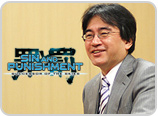
Iwata Asks

Sin and Punishment: Successor of the Skies

1. The N64 Controller Provides Inspiration

Iwata:
Thank you for taking time out of your busy schedules today.
Maegawa:
It’s a pleasure. Thank you for having us.
 Iwata:
The previous incarnation of Sin and Punishment1, for the Nintendo 64, is a bit of a cult classic. I’ve asked you to come all the way here to Kyoto because I’d like to ask your help in conveying to as many people as possible what kind of people make Sin and Punishment and what is so great about it. I’m counting on you.

1Sin and Punishment: a shooting game developed for the Nintendo 64 and released only in Japan in November 2000. Since September 2007 the game is also available in Europe on the Virtual Console for 1200 Wii Points.
Maegawa:
We’re happy to help.
 Iwata:
First, I’d like our guests from Treasure2 to introduce themselves.

2Treasure Co., Ltd.: A video game developer founded in 1992 with particular expertise in action and shooting games. Among the many games it has been involved in developing are Mischief Makers, Ikaruga and Wario World.
Maegawa:
I’m Maegawa, president of Treasure. I served as producer on Sin and Punishment: Successor of the Skies.
Nakagawa:
I’m Nakagawa from Treasure. I was director this time, so in addition to my main job as programmer, I also did planning or whatever else came my way.
Suzuki:
I’m Suzuki, a designer. I was an employee of Treasure when the first game came out, but now I’m a freelancer. I lent assistance this time as art director.
Iwata:
You all worked on the previous game, right?
Maegawa:
Yes.
Iwata:
I would like to hear how the first game began and how you made it.
Maegawa:
All right. It all began with the Nintendo 64 controller. At the time Nintendo had suggested two ways of holding it, left position and right position3, but most games called for the right position.

3Left and right positions: For right position, players would hold the right grip with their right hand, and use the thumb of their left hand to operate the analogue stick. For left position, players held the left grip in their left hand and used the thumb of their right hand to operate the analogue stick.
 Iwata:
Mario 644 used the right position, so everyone used that.


4Super Mario 64: The first Mario 3D action game, released simultaneously with the Nintendo 64 in Europe in March 1997.
Maegawa:
We started talking about how anyone hardly ever used the left position, even though you can perform independent actions with it.
Iwata:
You can do some unique controls, but no one used it.
Maegawa:
Right, no one used it. But we thought it would make for an interesting way to play the game and started development.
Iwata:
So Sin and Punishment began with you deciding to make full use of the left position.
Maegawa:
Yes. We thought maybe you could aim with the analogue stick and move with the +Control Pad in the left position.
Iwata:
How did that work out as you began development?
Maegawa:
We realised that the independent operations in the left position would be unexpectedly hard for players the first time they tried it.
Iwata:
Because they’d never done it before.
 Maegawa:
And Nintendo told us that. What’s more, a Controller Pak5 could be plugged into the Nintendo 64 controller, and there was talk of adding a sensor to it. But we had already begun development for the left position. Adapting it to a sensor at that point would have only lengthened a development process that was already dragging on. We abandoned it, but after some time had passed, the Wii arrived…

5Controller Pak: An accessory for the Nintendo 64 controller. It could be inserted into the bottom and used to save game data, etc.
Iwata:
That’s quite a long time! (laughs)
Maegawa:
It sure is! (laughs) When I saw the Wii Remote, I thought, “So this is the sensor they were talking about!”
Iwata:
Ah, I see.
Maegawa:
So I said, “Come on, let’s make Sin and Punishment for Wii!” and started bugging these two about it.
Nakagawa/Suzuki:
(nod in agreement)
Iwata:
(laughs)
Maegawa:
We thought, “We could use the Wii Remote’s pointer to aim and the Nunchuk to move! That’s it!” And that’s what got us started.
Iwata:
Wait, not so fast! Before we get into the Wii version, I want to hear about the original game! (laughs)
Maegawa:
Oh, right. (laughs)
Iwata:
About when did development of the N64 version begin?
Maegawa:
It went on sale in 2000, so… The setting for the original game was 2007 viewed as the near future and the story was supposed to occur ten years in the future, so we probably submitted the proposal around 1997.
Iwata:
The near future? 2007 has already passed! (laughs)
Maegawa:
Yeah. (laughs)
Iwata:
For a game that was developed back then, Sin and Punishment took a relatively long time. And it went on sale during the last days of the N64. It was like you just barely caught the last train. (laughs)
Maegawa:
Sorry. (laughs)
Iwata:
Not at all. To tell the truth, I ran into some trouble in the days of the N64 myself. Back then, I was president of HAL Laboratory, Inc. The Nintendo 64 came out in 1996, but until 1999 and the release of Smash Bros.6 and Pokémon Snap7, HAL Laboratory wasn’t able to contribute much in the way of new products.

That was because the Nintendo 64 drastically changed how things were made up through the Super NES. We ran up against how to make the best use of 3D graphics, and the team had quite a hard time.

About that time, in 1997, you wrote the proposal for Sin and Punishment, and the game came out in 2000. Could you tell me a little about the process of trial and error you went through at Treasure during that period?

6Super Smash Bros.: A fighting game released for the Nintendo 64 in Europe in November 1999.

7Pokémon Snap: A camera-adventure game released for the Nintendo 64 in Europe in September 2000.
Maegawa:
Maybe it would be best for our programmer Nakagawa to talk about that…
Nakagawa:
Okay, um…as Iwata-san just mentioned, how video games are made changed drastically with the Nintendo 64.
Iwata:
They sure did. It was a huge change.
Nakagawa:
But before the Nintendo 64, there had been some systems by other companies that were like 3D graphics entry-level consoles. So when it came to 3D know-how…
Iwata:
You already had some.
Nakagawa:
Yes. I was certain I could make it work for the Nintendo 64, but the Nintendo 64 was…it was really something. (laughs wryly)
Iwata:
(laughs) If you didn’t do it well, it wouldn’t work at all.
Nakagawa:
Right…that’s exactly it. It just wouldn’t work…
Maegawa:
I was a main programmer at the time, so I really understand what he went through.
Nakagawa:
Before the Nintendo 64, there were only entry-level consoles in terms of 3D capabilities, right?
Iwata:
Yes.
Nakagawa:
But the Nintendo 64 was truly a 3D machine.
 Iwata:
That’s because we adopted the architecture from Silicon Graphics, Inc.8 Nintendo 64 had a number of restrictions, but it truly was a full-blown 3D machine. Nonetheless, the limits it had were such that, unless you used it right, it wouldn’t run well.

8Silicon Graphics, Inc.: An American company that was at the forefront of 3D graphics processing technology. Established in 1982.
Nakagawa:
I’d been enjoying working on the entry-level machines, but when I suddenly got my hands on a machine for real pros, for about a year it just wouldn’t work…
Iwata:
Uh-huh.
Nakagawa:
(silently stares into the distance)
Iwata:
It…wouldn’t work?
Nakagawa:
Sigh… (long sigh)
Iwata:
(laughs) That sigh was laden with meaning. (laughs)
Nakagawa:
(nods exaggeratedly)
Iwata:
(laughs)

2. Painful Memories

Iwata:
It seems your experience developing Sin and Punishment for the N64 was so painful it still causes you to sigh loudly. Could you tell us exactly what happened?
Nakagawa:
Well, the crosshairs in an aim-and-shoot game move in 2D, but…
Iwata:
The game world is in 3D.
Nakagawa:
Exactly. You have to use 2D aiming to hit a 3D opponent with a bullet. I was like, “How am I supposed to do that?!” And that’s how it all began.
Iwata:
I see.
Nakagawa:
So I tried a bunch of stuff, and eventually figured out how to hit enemies with bullets.
Iwata:
I see.
Nakagawa:
But then next… (makes a pained face)
Iwata:
Next?
Nakagawa:
The opponent’s bullets wouldn’t hit you.
Everyone:
(laughs)
Iwata:
Ah, opponents couldn’t hit the player. (laughs)
Nakagawa:
When the player character isn’t on the screen, you can fudge it, but we were making a game with a visible player character, so there could be no fudging it.
Iwata:
If it were just a little off, it would be unnatural and not feel right.
Nakagawa:
That’s right. So many painful memories… Like with the bosses, too.
Iwata:
The bosses?
Nakagawa:
Bosses have to be big so they make an impact. If they aren’t…
Iwata:
They’re not a boss.
Nakagawa:
Right. But in 3D, they’re way back in the screen.
Iwata:
Which is normal.
Nakagawa:
When we put them on the screen, though, they were so small. We were like, “That’s not a boss!” In reality, they were really big.
Iwata:
They were really big, but looked really small.
Nakagawa:
(with a pained expression) Yeah…
Iwata:
What a problem. (laughs)
Nakagawa:
Yep. In Sin and Punishment, you can get up close and attack, so I thought the bosses’ large size would be apparent then. But up close, they were too big!
Iwata:
(laughs)
Nakagawa:
(with a troubled expression) They wouldn’t fit on the screen.
Iwata:
When one came close, you couldn’t tell if it was a boss or something else.
Nakagawa:
Right. You couldn’t see anything but a big foot. You would think, “Well, this is probably a boss…although maybe it’s actually just a foot.”
Everyone:
(laughs)
Iwata:
So many painful experiences.
Nakagawa:
(nods in silence)
Iwata:
When Sin and Punishment came out, I thought it was a very ambitious game. I thought, “They sure have big aspirations for the Nintendo 64!” Nakagawa-san, were you originally the type to enjoy pushing boundaries?
Nakagawa:
Yes. (firmly)
Iwata:
I thought so.
Nakagawa:
I like it…but it’s hard.
Iwata:
(laughs)
Maegawa:
He’s always been that way, challenging the hardware limits of the NES, and so on.
Iwata:
In the days of the NES and Super NES, digging up uses of the hardware that weren’t in the specifications and being pioneers was a sort of bliss for programmers.
Maegawa:
That’s right.
Iwata:
I would get frustrated when I ran across something in another company’s game that I had no idea how they had accomplished, but I would be pleased when I saw how surprised people were by something we had made.
Maegawa:
I know what you mean. We continued on in that spirit when we made the Nintendo 64 version.
Iwata:
So, Nakagawa-san, you kept your shoulder to the wheel and…
Nakagawa:
Yes. Then we ran into a wall of colossal proportions. Not just trouble in programming, but in design as well.
Iwata:
You had trouble, too, Suzuki-san?
 Suzuki:
Yes. In design, I remember having particular trouble with texture mapping.9

9Texture mapping: Laying images on 3D objects to establish differences in textures and characters.
Iwata:
With the Nintendo 64, the size of textures was severely limited. If you didn’t contrive something clever when making the data, the processing speed would drop dramatically.
 Suzuki:
That’s right. In order to avoid that, we tried things like removing bones.10 It was a matter of whether or not we could turn the constraints into a positive feature.

10Removing bones: Decreasing the number of joints in a 3D model.
Iwata:
By the way, there’s a tendency these days for a large number of people to be involved in the development of a game, but at Treasure you do powerful work with small numbers.
Maegawa:
Yes, I suppose so.
Iwata:
I’m often surprised by what you accomplish with a team of such size. I have the impression that you make incredibly powerful games.
Maegawa:
Well, we go about it rather frantically…
Nakagawa/Suzuki:
(nod repeatedly)
Iwata:
(laughs)
Maegawa:
I basically hold the policy of letting the staff make the game however they like. But if, say, 30 people each tried to make what he or she truly liked, they would never agree on anything. Everyone would have their own opinion, saying, “This is what I want to do!” “The few and the proud” isn’t just a cool-sounding philosophy. You really can’t make anything with large numbers.
Iwata:
With too many people, it just doesn’t come together. (laughs)
Maegawa:
Right. You need someone, like Nakagawa this time, to be director and programmer and pull it all together. That’s why in the first stage of this project we had the absolute minimum staff - two programmers and two designers - make the game’s core elements, and began with just a few people.

Of course, in the end more people were involved than ever before in Treasure’s history.
Iwata:
When those core elements were established, I had you show it to me, and even then I felt like it had substance.
Maegawa:
As I’m sure you’re well aware, back in the days of the NES, one person could make a whole game.
Iwata:
That’s right. Once upon a time, there was just one programmer. It was normal for the whole team to consist of only three people.
Nakagawa:
Even now, Treasure is like that!
Iwata:
(laughs)
Maegawa:
Even today it’s normal for three people to be a team at our company. That way they can do what they want and really make it stand out.

But it’s not like that’s the only reason I insist on my policy of working in small numbers. The reality simply is we don’t have many people…
Nakagawa/Suzuki:
(nod in agreement)
Iwata:
(laughs) To put a good spin on it, you want to make the most of each individual’s energy when making something.
Maegawa:
Yes, but to say we just do whatever we want wouldn’t be wrong either. (laughs)

3. The Phantom Title: Dark Wasteland

Iwata:
Now I’d like to ask some questions to the Nintendo staff. Yamagami-san, you worked on the previous game, right?
Yamagami:
Yes. I was the producer this time, but I was director for the N64 version.
Iwata:
Yamagami-san, what was it like working together with Treasure then?
Yamagami:
To put it bluntly, they were a weird company.
Everyone:
(laughs)
Yamagami:
Maybe it just shows how limited my experience was, but among all the people I had worked together with…
Iwata:
They were different from any other company.
Yamagami:
Exactly. They were different. Even now I often say that among all the companies I’ve dealt with, they’re in the top three most difficult.
Maegawa:
(laughs)
Yamagami:
And what’s more, the original Sin and Punishment is among my top three most difficult games to develop. As for what was so difficult, usually when you ask when it will be done, the director will give you an estimated date.
Iwata:
Whether they can make that date is another thing, but they will give you an estimate.
Yamagami:
But with Treasure, they say, “We don’t know. We’ll show you something when it’s done.” I’d say, “Well, that causes some trouble,” and they’d say, “But if we don’t know, we don’t know.” We went back and forth like that for a long time.
Iwata:
They’re polite about it, but what they’re really saying is “No idea” over and over again. (laughs)
Yamagami:
Right. Then they’d say, “Anyway, we’ll do our best.”
Iwata:
And in truth, you were doing your best, right?
Nakagawa:
(nods in silence)
Iwata:
(laughs)
Yamagami:
Then after I’d waited a while, the prototype was done. When I played it, I was amazed.
Iwata:
You wondered how they could do anything like that on Nintendo 64?
Yamagami:
You guessed it. I was truly amazed. And everyone at Treasure is a perfectionist, so the difficulty level was staggering.
Iwata:
I see.
Yamagami:
When I said, “It’s too difficult. I can’t do it,” they responded, “Then you’re not good enough to be in charge of this project.”
Everyone:
(laughs)
Yamagami:
When I said, “But normal people can’t do this!” they said, “Everyone in our company can do it. Anyone who can’t do this can’t be on our team.”
Iwata:
(laughs)
Yamagami:
That discussion dragged on for almost one year…
Maegawa:
Yeah, it went on for a while. (laughs)
Yamagami:
Saying “Make it easier” is easy, but if you do, it loses that distinct Treasure style.
Maegawa:
We wouldn’t be worth much if we crumbled just because we were ordered to do something. If you do something just because you’re told to, even though you don’t agree, the game will fall apart. But Yamagami-san was persistent in continually hammering away at our staff.
Yamagami:
If I had really laid on them, we probably could have brought the game out before 2000, but I told them I wouldn’t order them to make it easier. I kept saying, “I won’t order you to do it until you understand. I’ll keep talking to you until you understand.” If I hadn’t, there would have been no point in working with them.

Eventually, toward the end, the overall difficulty level did fall, but without losing that distinct Treasure flavour.
Iwata:
I see. By the way, it was Yamagami-san who came up with the title, wasn’t it?
Yamagami:
Yes.
Iwata:
How did you decide on that?
Yamagami:
At first, we were using the title Glass Soldier during development.
Maegawa:
Because the main character is fragile, like glass.
Yamagami:
Around that time, all the games coming out had titles in katakana, so I suggested thinking up a title using kanji.

Editor’s Note: Katakana is one of the three Japanese writing systems. Katakana is phonetically written, and is typically used to show how foreign words are pronounced. Kanji is another one of the three writing systems, and most of the Kanji characters can be pronounced in two or more different ways.
Iwata:
Yes, it wasn’t uncommon for games with titles in katakana to get buried amidst all the others coming out, but what was your reason for deciding on those particular words - sin and punishment?
Yamagami:
It just so happened that at that time one of the titles being developed by the Entertainment Analysis and Development Division was called Red and Black.
 Iwata:
Oh, you mean Perfect Dark.11

11Perfect Dark: A first-person shooter for the Nintendo 64 released in Europe in June 2000.
Yamagami:
Yes. Red and Black was the working title during development. It was eventually sold as Perfect Dark, but if Red and Black was all right, why not Sin and Punishment?

We thought that title might be too obscure, though, so we decided to add a subtitle that would make the theme more apparent. I consulted the younger staff members, and they suggested using kanji that typically reads Chikyu (Earth) but reading it hoshi (star). I thought, “That’s it!”

Editor’s Note: Although the typical way of pronouncing the Japanese Kanji for “Chikyu” (Earth) does not include “hoshi” (star), purposely giving Kanji characters alternate pronunciations by placing corresponding Hiragana or Katakana characters aside them is commonly done in Japanese pop culture to suggest alternate meanings.


So, in consideration of the theme of the story, we came up with Hoshi no Keishosha (Successor of the Earth).
Iwata:
And this time?
Yamagami:
I wanted a tie to the original game, so we looked for a similar title. Since this time the underlying themes in the background are larger in scale, we left chikyu (Earth) behind and decided on uchu (universe).
Iwata:
And suggested reading it sora (sky).
Yamagami:
But this time we used kokeisha (another word for “successor”), and settled on the subtitle Sora no Kokeisha (Successor of the Skies).
Iwata:
Maegawa-san, what did you think when the title changed from Glass Soldier to Sin and Punishment?
Maegawa:
I was surprised. (laughs)
Iwata:
I suppose it took some time to get used to it.
Nakagawa:
Um…I was glad about it.
Iwata:
You liked the title Sin and Punishment, Nakagawa-san?
Nakagawa:
Well, one of the other final candidates was really wild. I think it was Dark Apocalypse.
Suzuki:
No, it was Dark Wasteland.
Nakagawa:
Yeah, that’s it!
Iwata:
Wasteland?
Nakagawa:
At the time, I really didn’t want it to be Wasteland.
Iwata:
(laughs)
Maegawa:
And while we were using Sin and Punishment, we gradually took a liking to it.
Yamagami:
Yeah, we did.
Maegawa:
If we had released it as Glass Soldier, I don’t think the title would have grabbed people the way Sin and Punishment did.

4. Like Jazz Sessions

Iwata:
Yamagami-san and I had actually been talking for some time about making Sin and Punishment for Wii.
Maegawa:
Huh? Really?!
Yamagami:
Yeah. (laughs)
Maegawa:
I was surprised when I got a reply a mere three days after submitting the proposal. It can take up to a few months to hear results, so I was telling these two to take it easy.
Nakagawa/Suzuki:
(nod)
Yamagami:
When I received the proposal from Maegawa-san, I was really pleased with it, but I didn’t get to discuss it with Iwata-san until three days later.
Iwata:
If I’d been able to meet with Yamagami-san the same day it arrived, I would have approved it that very day.
Maegawa:
Really?!
Everyone:
(laughs)
Yamagami:
Three days later, I went to Iwata-san in a state of elation. I was like, “It’s here!”, “Let’s do it!”
Maegawa:
Oh, I see.
Iwata:
That was how we here at Nintendo decided to do it, but what made you at Treasure decide to do a Wii version of Sin and Punishment?
Maegawa:
Like I mentioned earlier…
Iwata:
The Wii Remote got you started.
Maegawa:
The weapon that appears in this game is called a Cannon Sword. It’s a gun and a sword, so slashing and shooting are the basic operations. We thought the Wii Remote was perfectly suited to those actions. I thought you could aim with the Wii Remote and use the Nunchuk to move the player character, so I started bugging these two about using that method for a Sin and Punishment sequel.
Iwata:
How did you feel about that Nakagawa-san?
Nakagawa:
As I mentioned before, I recalled my hardship with the Nintendo 64 game.
Iwata:
You’d been traumatised.
Nakagawa:
(nods in silence)
Iwata:
(laughs) You couldn’t just dive right in.
Nakagawa:
Nope.
Iwata:
Maegawa-san, how did you convince him?
Maegawa:
He had originally said he wanted to do it.
Iwata:
I wanted to, but…
Maegawa:
He definitely didn’t say he was against it.
Nakagawa:
(nods quietly)
Maegawa:
Then, when I said, “Let’s do it,” he was like, “I want to, but it’ll be hard, so just hold on a sec…”
Iwata:
It took a little time for him to come around. Suzuki-san, what did you think when they approached you about this project?
Suzuki:
Actually, I hadn’t been involved in video game production for some time. Development methods had changed so much, and making a new title or original had become so hard that I wouldn’t have minded never making another video game.
Iwata:
I see.
Suzuki:
I also work in illustration and manga. But since Nakagawa-san was going to be director, I thought it might be all right.
Iwata:
Why is that?
Suzuki:
He knows the technology and works painstakingly hard, never giving up no matter what happens.
Iwata:
He sticks it out to the very end.
Nakagawa:
(shakes head no)
Iwata:
(laughs)
Yamagami:
I told Treasure I definitely wanted Suzuki-san to participate. I knew he wasn’t there anymore, but I wanted the sequel to preserve the taste of the original.
Maegawa:
When you change designers, the style changes, resulting in a different game. That was something we couldn’t let happen.
Iwata:
When Suzuki-san joined the staff, how did you kick off development?
Nakagawa:
I told Suzuki-san to draw whatever he wanted.
Iwata:
Huh? Is that really what you said?
Maegawa:
We do that a lot at our company.
Suzuki:
Yeah, a lot.
Nakagawa:
(nods in agreement)
Maegawa:
All the time.
Iwata:
(laughs) I think that’s unusual for a director. It’s an interesting relationship that works that way without falling apart.
Maegawa:
Drawing up detailed specifications and developing strictly in line with them is also all right. When you do that, the finished product will turn out fine, but it will hardly be anything more than what was in the specs.
Iwata:
Ah, I see.
Maegawa:
Especially for action and shooting games that occur in real time, there’s an element of running them to see what happens. First you’ve got to get them moving and actually try them out. As you make repeated improvements, they rapidly get better.
Nakagawa:
But, you know…we’ve known each other for quite a long time now. When we first started working together, I did request some very specific illustrations, but…
Iwata:
But?
Nakagawa:
He always gave me something completely different than I’d asked for!
Everyone:
(laughs)
Iwata:
In other words, it doesn’t do any good to ask for anything specific? (laughs)
Nakagawa:
(nods)
Suzuki:
I was just giving them my own little twist.
Nakagawa:
But that probably goes for me as well. When someone says, “Here, I made this model, now move it so it looks cool,” as a programmer, I do it the way I want.
Suzuki:
And it can be fun to see movement that wasn’t specifically requested, right?
Iwata:
In other words, both designers and programmers ad lib off of each other, like, “Oh, that’s what he did? Then I’ll do this…”
Nakagawa:
Right, right.
Suzuki:
Right, right.
Iwata:
It’s like a jazz session. Is that how Treasure develops games, Maegawa-san?
Maegawa:
I think that’s exactly it. Unless each person is working independently in their own function, we never move forward.
Yamagami:
That’s why you always tell me to wait until it’s done.
Everyone:
(laughs)

5. Increased Difficulty

Iwata:
Thanks for your patience, Hattori-san and Matsushita-san. You’re both staff from Nintendo, when did you join development?
Yamagami:
I was surprised, but when Hattori-san saw the proposal for Sin and Punishment that I had received from Treasure, she said she wanted to work on it.
Nakagawa:
Huuuh?!
Maegawa:
Really?! That’s the first I ever heard about it!
Yamagami:
To be honest, I never imagined Hattori-san would volunteer to work on this.
Iwata:
I’m a little shocked, too.
Everyone:
(laughs)
Iwata:
Having participated in the past “Iwata Asks” for Nintendo presents: Style Boutique12, it seems like you have quite a dynamic range! (laughs)

12Nintendo presents: Style Boutique: A fashion-styling simulation game released for the Nintendo DS in Europe in October 2009.
Hattori:
(laughs)
Iwata:
You really did ask to be involved?
Hattori:
Yes. I volunteered. I think it’s the first time since joining the company that I’ve done that.
Yamagami:
I think she must have been incredibly interested in the game world of Sin and Punishment.
Iwata:
Ah, I see. Did you play the original game?
Hattori:
It was too difficult on the Nintendo 64, so I couldn’t.
Nakagawa:
(makes a pained expression)
Iwata:
(laughs) So Treasure could have said, “Anyone who can’t do this can’t be on our team!” and shut you out! (laughs)
Hattori:
That’s right! (laughs) I was extremely interested by the art on the packaging, the game world and what people around me were saying, but I thought I couldn’t join. It looked interesting, so I was really frustrated.
Iwata:
I see. Are you happy to hear your game could generate such interest, Suzuki-san?
Suzuki:
And from a woman no less! (laughs)
Hattori:
(laughs) I was frustrated, and also thought it was too bad more people couldn’t enjoy it. I thought maybe we could, not make it shallower exactly, but make it a little more approachable.
Iwata:
Keep the depth, but make it easier to tackle. Make it open to first-timers.
Hattori:
Exactly. It’s the same as with Style Boutique. That game is really deep.
Iwata:
After you joined the team, during the final adjustments, the game became more approachable, didn’t it?
Hattori:
Yes. I wanted to bring the same unintimidating atmosphere to Sin and Punishment as well.
Iwata:
I see. How did you become involved, Matsushita-san?
Matsushita:
I wasn’t officially involved at first. I had only tried out the game once it reached a certain stage. But when they went to give Treasure some feedback, I just happened to be in Tokyo.
Yamagami:
And we said, “Come join us!”
Matsushita:
I went with them, and Yamagami-san introduced me as part of the team. As we were talking everything over, I actually came to be on the team! (laughs)
Everyone:
(laughs)
Maegawa:
He was a big help. Matsushita-san knows a lot about shooting games, so it was great to have someone like him look at the game.
Yamagami:
Matsushita-san could play the game at the uppermost limits, and Hattori-san could handle the more newcomer-friendly aspects, so the team possessed great balance.
Iwata:
Hattori-san, what issues did you run across?
Hattori:
First I nailed down certain basic elements by making a solid tutorial and adjusting the difficulty to newcomers. As I worked, however, I thought perhaps we shouldn’t lower the difficulty without putting sufficient thoughts into the consequence.
Iwata:
If you did, it could fundamentally undermine the game.
Hattori:
That’s right. The original game has lots of fans, as does Treasure. There were certain elements of the games that are appreciated by them, which I wouldn’t want to change a bit.
Iwata:
Shooting games are a major example of a game genre that was standard and played by lots of people for a while but saw a shrinking fan base as many players were left behind.
Hattori:
That’s right.
Iwata:
All the people who were once enjoying shooting games hardly ever play them anymore, but many of them would say they actually like them, so you wanted to make it easier for those kinds of people to play this game, is that right?
Hattori:
Yes. I wanted them to enjoy playing it. And at the very least I wanted to avoid them being unsatisfied or getting beaten without ever understanding what was going on.

I think it’s the kind of game that is fun to learn and play and gradually improve at, so in my talks with Treasure, I mostly focused on aspects of the game that didn’t feel good, like moving on without ever really knowing what’s hitting you.
Iwata:
Nakagawa-san, what did you think when Nintendo brought these concerns to you?
Nakagawa:
I had really worked hard at the original game, so I thoroughly studied to be able to tell what a reasonable difficulty level would be.
Iwata:
Because you had fully discussed it with Yamagami-san?
Nakagawa:
Yes. But this time as well, the development staff consists largely of hardcore gamers. They’d mostly been developing for the Nintendo GameCube controller, which they’re most used to, not the Wii Remote.
Iwata:
I see.
Nakagawa:
So we were making the game to be how we like games, and it was really difficult.
Iwata:
In true Treasure style. (laughs)
Nakagawa:
I was looking over their shoulders and thinking, “Nintendo’s gonna make us change this later on…” If I had said anything, though, it would have got their backs up, so I waited for Nintendo to do it.
Iwata:
Because you didn't want to say it yourself, you let us do the dirty work! (laughs)
Nakagawa:
That’s right. But the feedback was the exact opposite!
Iwata:
Huh?
Nakagawa:
You guys said, “It’s too easy! What’s the deal?!”
Everyone:
(laughs)
Nakagawa:
They said, “The enemy gets wiped out in no time.” When I said, “But it’s supposed to be really difficult,” they said, “Fans will never approve of something so easy.”
Iwata:
We said that? To Treasure?
Nakagawa:
Right. It turns out that with the Wii Remote it’s easier to aim, so you totally clean house.
Iwata:
Oh, I see.
Yamagami:
The Wii Remote is particularly suited to shooting.
Iwata:
That’s why it was easy to defeat the enemies. But did you actually tell Treasure, of all companies, to make it more difficult? (laughs)
Matsushita:
Yes. During the last stage of development.
Hattori:
I had voiced my concern over the fact that even I could clear it without losing once. (laughs)
Iwata:
Now that certainly is surprising! (laughs)
Matsushita:
In the original game, you couldn’t aim at both left and right opponents at the same time. But with the Wii Remote, you can shoot to the right, and then immediately shoot to the left, so you can almost simultaneously target all enemies on the screen. We needed to make adjustments for the controllers.
Iwata:
But it isn’t easy to adjust the difficulty balance. Some players want to use the Wii Remote, some want to use the Nintendo GameCube controller, and the game is also compatible with the Classic Controller.
Yamagami:
In the end, we created places where the Wii Remote would be most advantageous, and places where the Nintendo GameCube controller or the Classic Controller would be most advantageous, deciding location by location within the game.

So, played as a whole, whichever controller you use, it’s fun. But if you were to change controllers for each location - to the Wii Remote, for example - you might be able to seize the advantage anywhere.
Iwata:
Well, if you did that, it wouldn’t be much fun. (laughs) But it really surprises me to hear you say that Nintendo told Treasure to make it more difficult. If it weren’t for “Iwata Asks,” I’d never have known!
Everyone:
(laughs)

6. Experiencing 60 Frames per Second

Iwata:
Lastly, I’d like each of you to talk about something you feel is a favourable aspect of the game. Let’s start with Matsushita-san.
Matsushita:
This time I learned how hard it is to make a sequel. Especially since the original game was so highly rated. For that reason, we developed the game with fans of the original in mind, particularly during the latter half of development. I would love to hear the reaction from fans of Sin and Punishment.
Iwata:
You’re looking forward to it, but…
Matsushita:
I’m also a little afraid. (laughs)
Iwata:
Is it a good fear?
Matsushita:
You might say that. (laughs)
Iwata:
All right, next is Hattori-san.
Hattori:
Earlier, the guys from Treasure said that everyone on the team made the game however they liked. I think that is reflected in the contents of the game, because you can play Sin and Punishment: Successor of the Skies however you like. The system follows one route, but you can choose whichever controller you like best. There is no predetermined way to achieve a high score.
Iwata:
The game doesn’t have a right answer.
Hattori:
That’s right. You might think that using a certain controller on a particular screen will get you a high score, or that since you’re getting different scores in the air than you are fighting on land that you should try something else, or that you’ll get better scores by taking out the enemy in a particular order. It’s an incredibly interesting game for exploring various strategies. I’d like players to work together in finding the right way for them.

When you check the ranking, you may find that people using a certain controller are getting higher scores. It’s a game that inspires friendly competition over ranking, too, so I hope players will also enjoy that.
Iwata:
You can play this game with Nintendo Wi-Fi Connection, right?
Hattori:
Yes. You can see the rankings for the whole country there.

Editor’s note: In the European release of the game players can see the ranking of players in Europe and the US.
Iwata:
Okay, Yamagami-san?
Yamagami:
Some people who learn about this game from this session of “Iwata Asks” might think it’s not a game for them since we got a little core about it sometimes, but I don’t want them to think that.
Iwata:
Because you made it so anyone can enjoy it.
Yamagami:
Right. Among those of us who worked on the game, I’m the worst at playing it. I lose all the time. But even if you are beaten, there’s no need to start over from the beginning. You can easily progress from stage to stage, so those who just want to experience the world of Sin and Punishment can fully enjoy it.
Iwata:
The world of Sin and Punishment has always been grand in scale.
Yamagami:
That’s right. Part of this incredible, epic, profound and mysterious world is recreated within the game this time, and Nintendo’s website for the game introduces it from that angle. I hope even players who aren’t that great at shooting games will enjoy this game world.
Iwata:
Maegawa-san, if you would, please.
Maegawa:
We originally had hardcore fans in mind, and I think we succeeded in making a game that they can enjoy. As Yamagami-san just mentioned, however, the easy mode serves as an introduction to shooting games, so I’d like to say to people who have never played this kind of game that its old-fashioned style of dodging, shooting and competing for top scores can be really fun.

We talked about making the game however we liked, and I think that’s because this type of game is so enjoyable.
Iwata:
Shooting games were once mainstream.
Maegawa:
That’s right. Dodging, shooting, comparing scores - playing on the edge of your seat - is fun for people everywhere. I think the fun crosses borders. What’s more, this time we made it at a frame rate13 of 60 frames.

13Frame rate: The number of times the image on the screen is refreshed per second. Most games run at 30 frames per second. Sixty is particularly suitable for fighting and racing games.
Iwata:
Why did you decide on that?
 Maegawa:
Just about the time development of Sin and Punishment began, Mario Galaxy14 came out. When I heard it was being made at 60 frames per second, I thought we should do the same thing.

14Super Mario Galaxy: A 3D platform game released for the Wii console in Europe in November 2007.
Iwata:
(laughs)
Maegawa:
So we really worked hard and made it 60 frames per second. When you play it, the difference is obvious. The movement is so much smoother.
Iwata:
It is clearly different when you play it.
Maegawa:
But you can’t tell the difference with screenshots.
Iwata:
And even if you show videos on the Internet, they don’t run at 60 frames per second. For example, we could have everyone watch videos on the Nintendo Channel15, but unfortunately they wouldn’t show at 60 frames per second.

15Nintendo Channel: Users can see information related to Wii and Nintendo DS here, and download DS demos. It can be viewed from the Wii Menu. For information on the Nintendo Channel, click here.
 Hattori:
That’s why we’re having a demo version available in select stores.16 I hope everyone will go try out the game.

16Select stores: The demo version of Sin and Punishment: Successor of the Skies was playable at participating retailers during the Japanese release.
Iwata:
Nakagawa-san?
Nakagawa:
Let’s see, um…I’ll finish up from my angle as a programmer. Given the hardware performance, we have done something pretty sophisticated, almost impossible, and the contents, as usual, are a real jumble. We really outdid ourselves, so, uh…
Iwata:
So…?
Nakagawa:
So please check it out!
Iwata:
(laughs) That leaves you, Suzuki-san.
Suzuki:
I’ll represent the designers. This time we had more volume to work with, so we packed in as much as we could. We focused heavily on having all kinds of opponents and movement in the vast background. You can play many times and always discover something new.
Maegawa:
Suzuki makes an astounding amount of materials, which really kept everyone on their toes! (laughs) The opponents are innumerable!
Iwata:
It’s almost unthinkable with a team of this scale. This volume, with just this many people…
Suzuki:
Earlier we talked about making it feel like the original, but I assembled it from the start as a new game. I think I could do that without restraint because I designed the original.
Maegawa:
Some people are saying it’s much brighter.
Suzuki:
I always want to make something new, so I added increased colour, and brightened it up.
Iwata:
You want players to enjoy differences like that.
Suzuki:
Yes.
Iwata:
I guess I’m last.

As games grow with the times to be larger in scale, teams operate more systematically, specialisation increases, and the sphere of each person’s work narrows. Maegawa-san’s approach could be said to place an incredible burden on each individual when making a modern large-scale product.

Nonetheless, you say, “We don’t have someone dedicated specifically to planning. The individuals who draw and program do the planning.” You consistently implement that approach, and make some solid products.

This time in “Iwata Asks,” I ended up hearing things entirely different than I had imagined beforehand, and truly found them interesting.

I sincerely hope we are able to convey to as many people as possible the great amount of passion and energy that you have put into this game.

You’re not the type to brag, so I hope players will experience through the game your energy and the enthusiasm you have poured into it. Thank you for your time today.
Maegawa:
Thank you for inviting us.
Iwata:
By the way, Maegawa-san.
Maegawa:
Yes?
Iwata:
I’ve dealt with a lot of teams with different personality compositions…but Treasure’s is certainly unique. (laughs)
Everyone:
(laughs)
Iwata:
Of course, I mean that in a good way.
Maegawa:
Well, thank you! (laughs)
 

Discover more about Sin and Punishment: Successor of the Skies at the official website.

Visit the Sin and Punishment website
Attention!

You are about to leave the Nintendo of Europe site. Nintendo of Europe is not responsible for the content or security of the site you are about to visit.

Cancel Continue