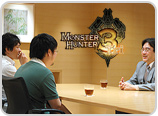
Iwata Asks

Monster Hunter Tri

1. An Online Game Anyone Can Play


(Editor’s note: The original interview was posted on the Japanese Wii.com site in July, 2009.)
Iwata:
Thank you for coming today.
Tsujimoto and 
Fujioka:          

Not at all. Thank you for having us.
Iwata:
Some of our readers may wonder what’s going on if I sit here and ask questions to staff from other companies, but since you put so much effort into this title, I want to tell as many people as possible about the game’s appeal. That’s why I asked you to come all the way here to Kyoto. I think it would be great if we could have a discussion from a different angle than usual.
Tsujimoto and 
Fujioka:          

It’s our pleasure.
Iwata:
I’d like to begin with self-introductions. Tsujimoto-san, would you mind starting?
Tsujimoto:
Sure. I’m Tsujimoto, producer of Monster Hunter Tri.
Fujioka:
I’m Fujioka, the director.
Iwata:
What did each of you work on before Monster Hunter Tri?
Tsujimoto:
I entered Capcom as a planner of arcade games. After I switched over to consumer games, I was planning online software, like racing games, more than anything else.
Iwata:
Since about the time online games took off?
Tsujimoto:
Yes, that’s right. For the original Monster Hunter, I was involved in planning and administration in matters related to online play.
Iwata:
When did you become a producer?
Tsujimoto:
I became a fully fledged producer around the time the series came out on a handheld device in 2007.
Iwata:
So you’re a producer who knows the situation on the ground.
Tsujimoto:
Yes.
Iwata:
How about you Fujioka-san?
Fujioka:
I joined the company as an arcade art designer. I was mostly doing pixel-based animation.
Iwata:
Compared to game design today, those were completely different times.
Fujioka:
Yeah. (laughs) But I got to study animation, and when it comes to expressing movement, I don’t think matters are all that different today. I’m still able to draw upon the importance of movement that I learned back then, so I’m glad I was able to study those basics.
Iwata:
Yes, it’s true that those who have learned both the older and newer methods have more to draw upon, giving their work more depth.
Fujioka:
That’s right. I was mostly making fighting games, but the company decided to begin serious development of online games. The game didn’t have an official title at the time, but everyone was called to what is now the “Monster Hunter” team. They wanted me to keep an eye on the younger designers.
Iwata:
So you were like an advisor at first. How did you become director?
Fujioka:
I was the type to harp on about the contents of the game, and they were like, “Well, if you’re going to be such a pain about it, why don’t you just become director?” (laughs)
Iwata:
Oh, I see. (laughs) If they’re fired up about it, delegate important work to the young and energetic folk. Is that the Capcom way?
Fujioka:
I suppose so. (laughs) But I wanted to remain a designer. Besides, I didn’t know what a director was supposed to do. Everyone said I should do it, though, so I decided to take it on and see how it went. Anyway, broadly speaking, there are two Monster Hunter series.
Iwata:
Home console versions and portable versions.
Fujioka:
Right. While I’m the director of the console series, I’m involved with the handheld versions in a supervisory capacity.
Iwata:
How did creation of Monster Hunter originally begin?
Fujioka:
As mentioned earlier, the company decided to seriously tackle online games. So there was the racing game Tsujimoto worked on, and something like a spin-off of Resident Evil, and then, focusing more on heavy action elements, we decided to make Monster Hunter.
Iwata:
The first game for home consoles came out five years ago in 2004. When did you begin planning?
Fujioka:
Seven years ago.
Iwata:
Is there anything that hasn’t changed in the seven years since your original concept?
Iwata:
When you can’t do something on your own, join together with others.
Fujioka:
Exactly. As monsters are moving around their environment, you work together with others to slay them. You take various materials, such as their hide or tusks, and use them to make new equipment for yourselves. That was the concept from the initial stage of development.
Tsujimoto:
The first concept was put forward as “an online action game,” but we always tacked on the words “that anyone can join and play.” That was a very important point. In general, when you talk about online games, you imagine people plunging in and really hitting it hard. But what we aimed for in this game was “leeway”. So, for example, we tried to create an atmosphere in which, if you enjoy cooking meat, that’s all right. We made it so that if you just enjoy fishing, that’s all right.
Iwata:
When I hear that about fishing, I think of Animal Crossing. (laughs)
Tsujimoto and 
Fujioka:          

(laugh)
Iwata:
Of course, the way it looks and the game system are completely different, but there is a similar aspect within the basic concept.
Fujioka:
Yeah. Everyone goes online and enters the same world, but not everyone has to do the same thing. Each person can do his or her own thing, but when the group achieves the goal, everyone benefits.
Iwata:
There’s leeway to do your own thing.
Fujioka:
Yes. We designed it so it wouldn’t take too much time to play - so each quest1 would take about one hour at most. Online games at the time tended to take a while to play.

1Quest: Tasks requesting a hunter to defeat monsters, transport goods, gather items, etc. Upon completion of a quest, the hunter receives a reward.
Iwata:
Someone who plays a long time gets stronger, gaining a reputation as someone really great.
Fujioka:
Right. We wanted to change that as much as we could, even if it’s just a little. That’s why we shortened the time for clearing one quest. For example, if four players go on a quest, but one player says, “This time I just want to fish,” and the others agree, that’s all right.
Iwata:
The game works even if one player doesn’t participate in the quest.
Fujioka:
That was a basic part of the game design for Monster Hunter from the start.

2. Affinity with a Popular Manga

Iwata:
Fujioka-san, if someone who didn’t know anything about Monster Hunter suddenly asked you what kind of game it is, how would you - as simply as possible - answer?
Fujioka:
As simply as possible? I’m not sure. That’s difficult. I suppose I’d say, “It’s a hunting game.” But I guess a lot of people might not quite get what I meant.
Iwata:
When you hear “hunting game,” you get the impression of something savage.
Fujioka:
Yeah. When you talk about hunting, you get an image of something incredibly severe, but in making the game, I worried most about not letting it become too brutal.
Iwata:
If a game is excessively brutal, the gameworld gets too forbidding and isn’t a comfortable place to be.
Fujioka:
The actual actions you perform within the game are heavy in their own way. But while it’s that kind of world, you get various kinds of enjoyment out of it. I wanted to make a world that wouldn’t be brutal.
Iwata:
You can do whatever you want, so the heavier aspects aren’t oppressive.
Fujioka:
That’s what I had in mind. Of course, the overarching theme is hunting, so everyone moves with that objective before them. However, there’s some leeway, some freedom.
Iwata:
You can go fishing if you want.
Fujioka:
The home console series is especially like that. It’s got a lot of leeway. Dinosaurs are exciting for adults as well as children. That inspires you to enter into this world, and when you do, you find it’s an enjoyable one. I like that.
Iwata:
I see.
Fujioka:
To put it another way, I always think of this game as a theme park. Once you go in, you find a fun world, and just doing something there is fun.
Iwata:
Hunting in a theme park?
Tsujimoto and 
Fujioka:          

(laugh)
Fujioka:
You’d get in trouble if you did that! (laughs) But I do love theme parks. Once you enter, it’s a different space. You don’t particularly gain anything from it, but just being there is fun.
Iwata:
I understand. Just like a theme park, there’s a comfortable world, and monsters live there. You can hunt them, but those who don’t want to can go fishing. If you encounter a monster you can’t defeat on your own, you cooperate with others to defeat it. And after you beat it, you receive a reward. That’s fun, so lots of people keep playing. That’s what the Monster Hunter games are about, right?
Tsujimoto:
Thank you for explaining it so precisely for me. (laughs)
Iwata:
Am I basically right?
Fujioka:
Yeah. (laughs) That’s what I was trying to say.
Iwata:
But I imagine most people who don’t know anything about it think they have to hunt.
Fujioka:
Probably, but it’s not really true. Oh right, I just remembered something. When I first started making Monster Hunter, I had a certain world in mind that I was inspired by. Remember that old manga called Hajime Ningen Gyatoruzu2?

2Hajime Ningen Gyatoruzu: A comedy manga set in prehistoric times. It was created by Shunji Sonoyama and started appearing in 1974 in a primary school manga magazine published by Shogakukan. The same year it was made into an anime. (Editor’s note: The manga is known for the characters eating a comically illustrated piece of meat on a bone, or “manga meat”.)
Iwata:
Yeah. It’s got bones with meat on them.
Fujioka:
Right. (laughs)
Iwata:
It’s a caveman manga.
Fujioka:
Yeah. (laughs)
Iwata:
Hmm, that’s surprising. (laughs)
Fujioka:
There’s a lot of freedom in that world. Mammoths are stomping around all over. You slice off their meat and eat it, but you wouldn’t really call it brutal.
Iwata:
It’s actually sort of warm and laid back.
Fujioka:
You chop off some meat and gobble it up like it’s delicious. That easy-going outlook is very human. I like that feeling of just eating what you want to eat. I wanted to convey a sense of how fun that type of thing can be.
Iwata:
So everyone gets together and casually enjoys hunting.
Fujioka:
Right.
Iwata:
How did you decide on the title Monster Hunter?
Tsujimoto:
Originally, it was the development code.
Fujioka:
But we didn’t know if we could get the rights to the name.
Tsujimoto:
Or rather, we were certain we wouldn’t be able to.
Iwata:
That’s understandable. (laughs)
Fujioka:
Yeah. It’s a very simple title. (laughs) We thought we would definitely have to decide on a proper name at some point, but couldn’t come up with a new one, and just kept calling it Monster Hunter. We didn’t think we could get it, but we decided to check on it anyway…
Tsujimoto:
And we got it. (laughs)
Fujioka:
We were like, “Then let’s go with it!” (laughs) We’d been calling it Monster Hunter ever since we started development, so it had come to contain our image of the kind of game we wanted to make. Of course, we’d grown attached to it so it was great we could use it for the title. And once you hear it, you never forget it.
Iwata:
Yes, it’s memorable.
Fujioka:
Having a sense for words is important.
Iwata:
I’ve talked with Shigeru Miyamoto several times about what a great name it is. It’s easy to remember and makes an impression. You understand right away what the game is about.
Fujioka:
Thank you. I think it was incredibly good luck that we were able to use that title.

3. Starting from Zero

Iwata:
What were you thinking as you started on Monster Hunter Tri?
Tsujimoto:
The timing was right for being bold and building from the ground up. I’d worked with Fujioka on the home console series, but it seemed to us that somehow we had reached an end. So we decided to scrap everything we’d established so far, even the system, and build it again from the ground up.
Iwata:
You didn’t want to just graft on an extension to the existing material?
Tsujimoto:
No. We wanted to be bold and pack in ideas from the ground level up. That’s how much we felt we had run up against certain limits.
Iwata:
The challenge was how you would do it if you decided to start from zero and make something entirely new. But didn’t that make you uneasy?
Fujioka:
We were incredibly uneasy. Since we’d started making Monster Hunter, we had dealt with all kinds of people and formed a relationship with users, and many were saying that it could be much better. We ourselves had also frequently wondered while working on the series if we should have done something different. But it would have been difficult to do so if we keep the same framework as previous games.
Iwata:
So in order to achieve what you’d always wanted to but had been unable to, the only thing to do was go back to the ground level and start over from zero.
Tsujimoto:
There was another reason, too. It’s often said that, even with movies, making the third in a series is difficult. So there was a sense that figuring out what else to do for the third game…
Iwata:
Would be fateful for the series?
Tsujimoto:
That’s exactly what I thought. I wanted to make Tri something that would really surprise those who were used to the series and make them think “This is awesome!” and “This is exciting!”
Fujioka:
So we decided to rethink it from the ground up. It was really hard work, but we tackled it with a great deal of excitement. We enjoyed making each new thing one by one, and were amply rewarded for our hard work.
Iwata:
And even as you reformulated the game’s contents from the ground level up, you chose Wii as the platform.
Tsujimoto:
The fact that Wii appeared while we were thinking about revitalising Monster Hunter from the ground up was the best possible timing. We were certain we could provide fresh excitement through game control and we were excited about the challenge, so we decided to make the world of the new Monster Hunter for Wii. It is, of course, a sequel, but we addressed it with a fresh spirit as if we were making a new game.
Fujioka:
But at first we were just getting a feel for things. We didn’t know much about the Wii hardware and had no idea how much was possible with it.
Iwata:
With a machine you’re familiar with, you have a sense for what you need to do to achieve a certain effect, as well as for what can’t be done.
Fujioka:
That’s why we were so uneasy. But we felt like we were creating something new, so in some ways we were in a state of positive excitement.
Iwata:
What did you think when you first tried out Wii? For example, I imagine the first thing you thought with regard to visuals was that you might not be able to do much.
Fujioka:
Yes. To be honest…
Iwata:
By all means, be honest! (laughs)
Fujioka:
(laughs) Graphics aren’t really Wii’s best point, so...
Iwata:
So it would be hard to surprise people only with graphics.
Fujioka:
I think good graphics are an incredibly attractive aspect of games. Even before people play a game, they are aware of its general appearance.
Iwata:
That’s why everyone wants graphics with impact.
Fujioka:
So - setting aside high resolution and other details - when it came to creating impressive visuals, I thought it would be a challenge not to compromise. So I decided to press the boundaries of the console’s functions and urged the programmers and designers to aim for making new images.
Iwata:
You mean making new images that would maintain the style of Monster Hunter.
Fujioka:
Right. Besides, I think the most important thing with regard to graphics is what kind of images the designer wants to make. No matter what kind of specs the hardware may have, if the designer has a clear idea of what kind of images he wants to make and concentrates hard on his work, I think he can achieve them.
Iwata:
Well, having the raw skills to pull that off is one thing, but didn’t such work call for a lot of sense?
Fujioka:
Yes. While this isn’t only true for Wii, the world of Monster Hunter isn’t one into which you can just throw anything you want, so judgment was necessary in determining what to put in and what to leave out.

The designers have a strong desire to turn out all kinds of stuff in order to create stunning visuals. Sometimes I had to say, “The visuals aren’t that important here. In this game they’re more important in this other area,” and get them to set something aside.

On the other hand, the programmers had moments when they wanted to keep constraints in place, and I had to say, “No, we can’t hold back on that, but this over here could be restrained a little instead.” We had to find the right balance.
Iwata:
And that was your job, Fujioka-san?
Fujioka:
For the most part, yes.
Iwata:
You could make use of your strengths as a designer.
Fujioka:
I really nagged them about it, so they were like, “Well, the director insists, so we have no choice.” (laughs)
Iwata:
(laughs)
Fujioka:
Of course, building up each part wasn’t easy, but we were determined to make visuals based on the idea of coming and going seamlessly between land and sea, and we realised we could do it. That’s why I think it turned out well. Overcoming such obstacles gave the staff increased confidence.
Iwata:
Um, I’ll be straight with you.
Fujioka:
Yes?
Iwata:
I can tell Nintendo’s staff has really been galvanised by you.
Fujioka:
(laughs)
Iwata:
I can tell they feel like you did what they hadn’t yet. Besides, the enthusiasm you put into it is apparent in the graphics.
Fujioka:
I’m extremely pleased to hear you say that. (laughs) Generating great visuals was one of our main goals in bringing out Monster Hunter Tri for Wii.

Striking visuals were originally one selling point of Monster Hunter, so when we decided to bring Tri out for Wii, to be honest, many players may have been uneasy over just how much we could do visually. We thought that unless we got those types of people to think, “Oh, it’s totally all right,” we would have failed.

4. Staring at the Wii Remote

Iwata:
In a lot of different ways I can sense the spirit of “not wanting to lose” that Fujioka-san spoke of.
Tsujimoto:
The first project planning document that we wrote said, “Let’s make the best graphics ever seen on the Wii console!” Such statements could be found throughout that document with regard to other areas as well. It was clear there was a great deal of determination among the developers. Then Nintendo let us show a video trailer at the Nintendo exhibition.
Iwata:
You mean the 2007 Nintendo Conference3.

3Nintendo Conference Autumn 2007: A presentation held at Makuhari Messe in Japan in October 2007 for the mass media, distributors and others involved with the video game industry. On stage, a game trailer from Monster Hunter Tri was shown and demonstrations of Wii Fit were also performed.
Tsujimoto:
Right. At that time, we were able to show visuals using an actual Wii, and I was certain we would be successful. After that, all I had to do was tell the development staff to continue creating visuals of such a high standard for the game. (laughs)
Fujioka:
(laughs) Actually, even after the Nintendo Conference, we clashed with the designers several times. Since we had already released it, there was no way we could do something completely different from the trailer. The designers had always had that certain vision, so the visuals never foundered.
Iwata:
You set the bar high right at the start, and then tried to aspire to it.
Tsujimoto:
That’s why I think we were able to work from start to finish without changing that much.
Iwata:
Perhaps you could do that much more fully than a normal director because, based on your extensive experience - including your time creating pixel art - you were able to tell others; “When you do something here, something else needs to be sacrificed.”
Fujioka:
I suppose so. I am always showing off how I used to be a designer. (laughs)
Iwata:
That way they can’t pull the wool over your eyes.
Fujioka:
Yeah! You can’t fool me! (laughs) And I have the right to tell them they can do more.
Iwata:
I often do that myself with regard to programming. (laughs)
Tsujimoto and 
Fujioka:          

(laugh)
Fujioka:
So if they say, “We can’t do any more,” I say, “Well, if you cut back here you should be able to.” That’s how we proceeded with our work, and that gave birth to a positive tension among the designers. The result was something we could all accept.
Iwata:
Looking at the graphics objectively, I feel like the game’s visuals are one of the representative examples of what can ultimately be done with Wii.
Fujioka:
Thank you very much.
Iwata:
I think it has placed the Zelda team under a considerable amount of pressure. (laughs)
Fujioka:
I doubt that! (laughs)
Iwata:
Our work is spurring each other to new heights.
Fujioka:
Yes. Since we were able to create something good, the development team has grown quite confident.
Iwata:
So, while you were satisfied with the visuals, were you at a bit of a loss when you first saw the Wii Remote as to how it could be used for Monster Hunter?
Fujioka:
(laughs) Well, I’m the type who gets really excited when he sees a completely new kind of device. I was like that when the Nintendo DS and Wii were announced. I knew I was going to be able to create gameplay in an entirely new way and I thought that was great. Objectively speaking.
Iwata:
Objectively. (laughs)
Fujioka:
Yeah. Objectively. (laughs) But then when I tried it out, I was like, “Hmm.” (laughs) To put it without choosing my words too carefully...
Iwata:
Please, be honest. (laughs)
Fujioka:
Well, first of all, the buttons...
Iwata:
There weren’t enough? (laughs)
Fujioka:
Monster Hunter was originally made so you used all of the many buttons on the controller. So when we decided to make Monster Hunter Tri for Wii, I just sat and stared at the Wii Remote for a long time.
Tsujimoto:
Even before we had anything to put on the screen, Fujioka was holding the controller and thinking about it day and night.
Iwata:
You couldn’t figure out how to make Monster Hunter for the button-light Wii Remote?
Tsujimoto:
When we announced at the Nintendo Conference that Tri would be for Wii, people kept asking if they would have to swing the Wii Remote.
Fujioka:
Co-workers were asking me about it, too. “You’re releasing it for Wii, right? What are the controls going to be like?” (laughs)
Iwata:
They were worried it might not work out all right with the Wii Remote? (laughs)
Fujioka:
They kept asking, “So we’re gonna have to swing the Wii Remote?”
Tsujimoto:
But from the very beginning we weren’t thinking about swinging the Wii Remote to hunt. We wanted a method of game operation that wouldn’t be tiring.
Iwata:
Because it’s a game that some people will play for very long periods.
Tsujimoto:
So we decided to view the Wii Remote and Nunchuk as one controller, without thinking about the motion sensor. We started by asking how the game should be operated. How should the buttons function in order for the game to feel good and be fun?
Fujioka:
The unique methods of game control in the Monster Hunter series have always been a challenge.
Iwata:
They require fairly complicated use of your fingers - like pushing the stick slightly to one side while pushing a certain button.
Fujioka:
Right. But it’s also a game we’ve always wanted to be simple to play, so this time we started all over from zero with regard to game operation as well.
Iwata:
Which brings us back to what we were saying earlier about starting at ground level.
Fujioka:
That’s right. We tried to distance ourselves from the habit of thinking that a certain thing was tied to certain buttons. When we considered how to play Monster Hunter with the Wii Remote and Nunchuk, we thoroughly and repeatedly thought about what would physically feel right.

5. The Fun of Cooperating

Iwata:
About when did you finalise the operability of the controller and solidify the game specifications?
Tsujimoto:
Just before the Tokyo Game Show4 one year ago.

4Tokyo Game Show 2008: A trade show held in October 2008 at Makuhari Messe focusing on video games and other fields in computer entertainment.
Iwata:
A playable version of Monster Hunter Tri was presented then, right?
Fujioka:
That’s right. I made a ROM for the presentation. Even when people were telling me I had better burn it soon or I wouldn’t finish on time, I was still playing around with it.
Iwata:
I know how that is. It’s difficult to completely finish something unless you have a deadline. (laughs)
Fujioka:
(laughs) I was like, “I want this to be just a little more like so,” and, “Let me work a little harder here.” I wrestled with it, changing game operation, up until the last minute.
Tsujimoto:
With regard to game operation, we had a policy of not announcing anything until the Tokyo Game Show. Even if we were asked about it in an interview, we wouldn’t answer. That was because rather than convey it through words, we wanted to have people actually try it out and hear how they felt. When we did, we heard what we had wanted to hear more than anything else.
Iwata:
Which was?
Tsujimoto:
“I’m relieved.” That’s what everyone said.
Iwata:
Oh, I see.
Fujioka:
That was a big relief. Our unease over how to play the game with the Wii Remote finally disappeared.
Iwata:
The fans at the Tokyo Game Show really went wild over it.
Fujioka:
It was almost scary! (laughs) First thing in the morning, I saw hordes of fans rushing towards the Capcom booth. I thought, “You’ll still get to play even if you just walk slowly,” but I was extremely happy that they came.
Iwata:
A lot of people said Monster Hunter Tri was the biggest attraction at the game show, but I think there are still a lot of gamers who have heard the name but never tried it. Could you explain a little about what elements of Tri you designed for those people?
Tsujimoto:
There’s a mode called The Arena.5 In this mode, the screen is split in two, and two players can simultaneously enjoy hunting together. That way people who don’t know how to play can play together with someone who does and learn the basic actions.

5The Arena: One of the game modes of Monster Hunter Tri. It is designed for one or two players to easily enjoy co-op gameplay. Special stages offer a variety of challenges.
Iwata:
So first you’re initiated by someone close to you, and then you enter the online world.
Tsujimoto:
That’s right. I remember playing Super Mario Bros. on the NES with my friends when I was a kid. There were times when I stood behind one of my friends, watching him play and learning the right actions to take.
Fujioka:
But for today’s games, it’s most common for one player to dominate a single console. For more and more games, it’s difficult to find a stopping point once you start playing. So even if you see a game and think, “Oh, that looks like fun…”
Iwata:
You can’t play together.
Fujioka:
Right. That’s why we made the game so that when someone thinks, “That looks fun,” they can split the screen in two, and if they have two controllers, start playing right away. There’s no need to jump right into online play. First you can play offline with the screen divided in two with your friends or family. Then you can go online.
Iwata:
That makes sense.
Tsujimoto:
I think splitting the screen is pretty common for Nintendo titles.
Iwata:
Yes, we’ve done it a lot for Super Mario Kart and such games since the days of the Super NES.
Tsujimoto:
But until now we never had that idea for the Monster Hunter series. But this time, along with bringing it out for Wii, we decided to try splitting the screen for the first time.
Fujioka:
Because of the characteristics of the Wii hardware, the console is generally placed in the living room. So we wanted to create an environment that an entire family could enjoy.
Iwata:
A MonHun (Monster Hunter) population increase within the home. (laughs)
Fujioka:
I think the effects of players recommending a game to those close to them are huge.
Iwata:
Word-of-mouth publicity occurs across generations within the home. It may be the only place for that.
Fujioka:
Yes. A mother may start playing because of the influence of her child. We’ve seen such occurrences a lot with the handheld series. Dividing the screen is perhaps the most important aspect of the game that we included for those who have never played this series before.
Iwata:
It will be incredibly interesting to see how the game spreads.
Fujioka:
It’s the first time we have tried it too, so we are really looking forward to seeing the results.
Tsujimoto:
Something else we’re trying for the first time is storing data in the Wii Remote so you can carry it around with you.
Iwata:
And take it with you to a friend’s house.
Fujioka:
After all, we did make the game compatible with the Wii Remote! (laughs) So you go to a friend’s house, divide up the screen and slay some monsters, and then you take those results…
Iwata:
You take them home with you.
Fujioka:
It would be too bad if you went to a friend’s house, played, and didn’t get anything from it. It wouldn’t carry over into your next session. So we made it so that you can take a controller with you and return home with the rewards you’ve gained. I wonder how that will turn out too…
Tsujimoto:
It’s hard to imagine what will happen. We’ll have to wait and see.
Fujioka:
We can’t imagine what will happen, but I think it’s something interesting we could try precisely because the game is for Wii. Going back to the NES days again, when I was a kid, I really liked going over to a friend’s house to play videogames.
Tsujimoto:
It was quite exciting.
Fujioka:
I think it would be great if the Wii Remote encourages that.

6. A World in Flux

Iwata:
Another big appeal of the Monster Hunter series is going online and hunting together with your friends. I suppose there’s a chance some players will hesitate to do that.
Tsujimoto:
Yes, but when you’re connected to the network and your friends who have gone hunting are fighting monsters, you can read the chat messages, such as “Flash Bombs work against this monster” and “It doesn’t work to drop this one in a pit.” So even if you’re off fishing alone, you’re taking in information from skillful players.
Iwata:
Oh, I see. You can learn about hunting even while you’re fishing. (laughs)
Tsujimoto:
So the next time you participate in the hunt, you think, “Oh, that’s right, they said Flash Bombs work…” (laughs)
Iwata:
Then when you go on a hunt and try it out, it must feel great to see it work.
Tsujimoto:
I think so.
Fujioka:
This software is good for skillful players to share their knowledge with beginners.
Iwata:
You want to share the fun you’ve experienced with all your friends.
Fujioka:
Like, “At first it’s all right to just go fishing, but next time let’s take on some monsters together.”
Iwata:
“Next time I’ll let you deal the finishing blow.” (laughs)
Fujioka:
Right! Like that! (laughs) Besides, if you go hunting and get hit by a monster, a good player will skillfully help you out, like, “I’ll distract it!” or “Heal yourself now!” In that way, everyone cooperates with each other, so people who aren’t very good at first will gradually get better. Then, before you know it, you’re good at action games. As you build up experience, you’ll be able to do something really impressive. (laughs)
Tsujimoto:
Your comrades in hunting are your instruction manual, your strategy guide. Even if you play without reading the instruction booklet, everyone will teach you all kinds of things.
Fujioka:
That’s a good thing about online games.
Iwata:
I suppose it’s like that because Monster Hunter Tri is structured for cooperative play. If players fought and competed against each other, a lot of their energy would go into keeping others down.
Fujioka:
Besides, if you take some kind of action, it isn’t just you who benefits…
Iwata:
It’s everyone, right? Game theory-wise, I’d say it’s extremely well-structured.
Tsujimoto:
There’s nothing negative about participating. Everything comes back to you in the form of a positive. The degree of the positives changes with the odds.
Fujioka:
So it’s okay to mess up. I think it’s great to have a world where everyone laughs and gets along whether they fail or succeed. When we were still developing it and I saw the test players trying it out, that was what I noticed more than anything. Even when someone said, “Aw, I messed up,” they said it with a smile.
Iwata:
When you see that, you think, “We did well.”
Fujioka:
Yeah. When it isn’t all right not to succeed, that creates a lot of pressure. You don’t want to go online.
Iwata:
The freedom to fail is very important. Without it, the game gets depressing.
Fujioka:
Many people who aren’t very good at games don’t want to cause the other players trouble or fall behind the others.
Iwata:
If it were structured so that when you beat a monster, the most agile person was able to gather up all the rewards, not that many people would have played this game.
Fujioka:
If you structured it to be a competition for first, it would get brutal. We didn’t want to do that.

When we started work on the Monster Hunter series, most online games at the time were about trading items. A certain enjoyment could be derived from giving to others or receiving yourself, but contrary to that, we decided to make it so that basically when you receive something, the participants get it randomly. Then when we decided to structure it so that only the person who received it could use it, collaborative play became firmly established and it became an easy game to invite people to play.
Iwata:
One important condition for something to spread is how easy it is to invite others to join. I think Monster Hunter’s structure is incredibly well-designed in that respect.
Fujioka:
Thank you very much. The basic elements work well, I think.
Iwata:
While Monster Hunter Tri is a game that can be broken down into short sessions, really dedicated Monster Hunter players will spend hundreds, if not thousands, of hours playing. Why do you think people play it for so long?
Fujioka:
At first, I thought that if a lot is built into a game, people will spend more time playing it.
Iwata:
Right, that’s what you would normally think. There’s a lot there, so you play a lot. If there are a lot of scenarios and stages, you can play the game for a long time. That is the general way of thinking within the gaming industry that has caused game volume to inflate.
Fujioka:
But I realised that’s not true when I saw the recent phenomenon of the portable series. It really doesn’t have the volume for playing thousands of hours. When I saw those who were playing that long, they were doing the same things over and over again. They do gain some kind of materials as a result, but they’re not playing because of that. I feel like they keep playing for hours on end because they simply like playing with their friends.
Iwata:
In other words, their motivation isn’t playing a new scenario, advancing towards some kind of ending, or getting a new weapon. Lots of people play Monster Hunter games for thousands of hours because playing together with their friends in the world of Monster Hunter is fun.
Fujioka:
I think so.
Iwata:
So what have you prepared in Tri for those players who want to go at it for long periods of time?
Fujioka:
We put in a sort of “flux,” so when players play the same quest more than once, they’ll think, “It was like such-and-such last time, but this time it’s a little different.”
Iwata:
“Flux”? You mean slight changes?
Fujioka:
Yes. When you enter the same place, maybe there wasn’t anything there before, but now there is, so let’s check it out. Or there was only one monster before, but for some reason there are two now. Changes occur little by little. But it doesn’t occur consistently and according to a fixed plan. Certain little elements move randomly.
Iwata:
Oh, I see. So if you return to the same place repeatedly, something different might happen, which keeps things feeling fresh and alive.

7. Responding to Enthusiasm

Iwata:
Earlier you mentioned how hard it was to adapt the game for the Wii Remote and Nunchuk. Partway through development, you learned something that must have been a bit unexpected from Nintendo, didn’t you?
Tsujimoto:
Yes. (laughs) We heard about the Classic Controller Pro.
Iwata:
After you’d put all that hard work into adapting Monster Hunter Tri for the Wii Remote, were you discouraged?
Fujioka:
No, not at all. (laughs)
Iwata:
We even suggested that it would be released at the same time as Monster Hunter Tri. Until that time, that sort of proposal was unheard of.
Fujioka:
Yes, I could really tell that. This may sound a little rude, but we were like, “Nintendo is serious about this!”
Iwata:
(laughs)
Fujioka:
So we knew it wouldn’t be right if we weren’t serious, too.
Iwata:
You were already serious, weren’t you? From the beginning?
Tsujimoto and 
Fujioka:          

(laugh)
Iwata:
I could really sense your seriousness. We were acutely aware of how enthusiastically you were making Tri, so we wanted it to go well no matter the cost. If there was a reason it wasn’t going well, we wanted to do whatever we could to help. I thought it would be too bad if there were gamers who couldn’t get into Tri just because they couldn’t get used to the controller. I’m just gonna go ahead and say it (laughs), but we even discussed where the best place for the analogue sticks would be.
Fujioka:
Yeah. (laughs)
Iwata:
Looking back over Nintendo’s history of development for controllers, I don’t think we’ve ever discussed it so deeply with another company.
Fujioka:
It was unprecedented for us, too. (laughs)
Iwata:
Someone within Nintendo said, “What? You’re going to ask the development staff of another company?” But since we were going to make a new controller so that people who had played Monster Hunter before could play comfortably, I thought we should at least get the seal of approval from the game developers.
Fujioka:
To be honest, when we were first asked that, I thought, “Is it all right for us to decide?” We said what we thought would be a good spot for the analogue sticks, and when it turned out just like that, I was surprised.
Tsujimoto:
While we had been designing the game for the Wii Remote and Nunchuk, we had always been making it for compatibility with the original Classic Controller, too.
Fujioka:
That’s right. So even when it came to the Classic Controller Pro…
Iwata:
It came naturally.
Fujioka:
When we told you that game operation was somewhat awkward with the Classic Controller the way it was, and you eventually reflected that, we were truly grateful.
Iwata:
It was a new experience for us, too.
Fujioka:
We also had a great time as well, working it all out with Nintendo. When it comes to making a controller, you think in terms of millimeters - no, even smaller…
Iwata:
I suppose we were obsessing over strange details.
Fujioka:
No, that kind of dedication really resonated with me. I got a glimpse into a world where simply changing one tiny element has a big impact on how something feels. It was a lot like how, when we make a game, we will slightly alter the placement of a certain element so that the game feels much better to play.
Iwata:
That is what it means to be a true craftsman.
Fujioka:
It was incredibly interesting. And when you hear the reaction of people who have actually used the Classic Controller Pro, it’s extremely positive.
Iwata:
Is that so? If the team in charge heard that, I’m sure they’d be pleased. (laughs)
Fujioka:
I think making the controller during the same time period worked out really well for Monster Hunter Tri, too.
Iwata:
We had the Classic Controller Pro go on sale the same time as Monster Hunter Tri, but Nintendo would like it from now on if other software developers made use of it. We also released a new colour of the Wii console along with Monster Hunter Tri.
Fujioka:
I was really surprised when I heard that, too.
Tsujimoto:
I’ve talked about this with Fujioka before, but we wanted to make Tri one of those titles you buy together with hardware.
Fujioka:
We had a strong desire to make a game that gamers would want to buy the hardware for.
Tsujimoto:
About the time we were talking about that, we heard Nintendo was really going to bring out a black Wii. At first, we thought, “Really?” (laughs)

(Editor’s note: In Japan the black-coloured Wii console was released simultaneously with Monster Hunter Tri. In Europe, the black Wii first became available in November 2009).
Iwata:
It was something you could not believe right away? (laughs)
Tsujimoto:
Yeah. Then when we saw it, the colour change made for quite a different impression.
Fujioka:
It makes you want to sit the console in certain locations. And the colour really goes well with the blue slot illumination. It’s very cool.
Iwata:
However, when we tried to make the black hardware, the materials didn’t exist to satisfy Nintendo’s standards, so we had to make them. When I heard from the developers, I was flabbergasted. They said it was taking more than two and a half years to develop the materials. We just barely made it in time.
Fujioka:
It came out at just the right moment. In that respect, too, I think Monster Hunter Tri is an extremely blessed title.
Iwata:
If there is something that players are interested in but can’t decide whether or not to purchase, some kind of condition that stops them from buying something, I think it is our job to remove such obstacles as much as possible. Our response to such needs was the Classic Controller Pro and black Wii.

Okay, is there anything else you’d like to say to our readers in closing?
Fujioka:
Well, here at long last we’ve...
Iwata:
How many years has it been since development began?
Fujioka:
Three years since the project started. Two years since we actually started making the game.
Iwata:
So that’s why you said “at long last.”
Fujioka:
Yeah. (laughs) You can finally play it. You can finally take on Monster Hunter Tri - or, as the name implies, “try” it. I hope the series grows in popularity, and I made it in a spirit of challenging myself, so I hope people will explore every corner of it and enjoy it without any hesitation. (laughs)
Iwata:
You want players to feel free to jump right into the online world, right? (laughs) Tsujimoto-san?
Tsujimoto:
Monster Hunter Tri is a special title for us. We started all over at the ground level and made it a game that is sure to satisfy players who have been playing the series all along and will make them say, “I’m glad I ‘Tri-ed’ it.” I think new players will find it exciting too, so please give it a shot. You have my thanks in advance!
Iwata:
I’ll offer a few final comments, too. As someone who once made things myself, I can say that it is only very rarely that you find something this dense and with this degree of enthusiasm packed into it. I’ve introduced it here today because I encountered it and thought it would be great if I could convey the game’s appeals to as many people as possible.

To people who may have heard of the series but never actually played it, and of course to those who have played the series all along I want to say, “You don’t know what you’re missing if you don’t play this game,” - especially those who own a Wii. It’s a game with a great deal of breadth in gameplay, more breadth, perhaps, than it appears to have at first glance. I hope everyone comes to understand that.

Tsujimoto-san, Fujioka-san, thank you very much for today.
Tsujimoto and 
Fujioka:          

Our thanks to you, as well.
 

Discover more about Monster Hunter Tri at the official website

Visit the Monster Hunter Tri website
Attention!

You are about to leave the Nintendo of Europe site. Nintendo of Europe is not responsible for the content or security of the site you are about to visit.

Cancel Continue